
You pick up a supplement bottle labeled "clean," "vegan," and "natural," and you feel confident. Then you flip it over and find a list of ingredients you can barely pronounce. This frustration is more common than you might think. Many supplements marketed as clean or plant-based still contain synthetic fillers, artificial dyes, or excipients that have no business being in a holistic wellness routine. Knowing how to read beyond the front label is one of the most powerful skills you can build as a health-conscious consumer.
Table of Contents
- Understand what 'clean' really means for supplements
- Know what to look for: ingredients, excipients, and processing aids
- Verify supplement quality: third-party testing and certifications
- Apply a clean label workflow to vegan and holistic supplements
- Why clean supplements require more than branding: our take
- Where to find clean, vegan supplement options
- Frequently asked questions
Key Takeaways
| Point | Details |
|---|---|
| Clean label is not regulated | Brands interpret 'clean' differently, so check for simple, transparent ingredients. |
| Check excipients | True clean supplements examine inactive components, not just nutrients or herbs. |
| Third-party testing is essential | Certifications like NSF, USP, and ConsumerLab help verify supplement purity and safety. |
| Vegan is not enough | Vegan does not guarantee quality; combine ingredient screening with third-party checks. |
| Independent reviews add value | Trusted labs provide unbiased comparisons on label accuracy, purity, and potency. |
Understand what 'clean' really means for supplements
Here's the uncomfortable truth: "clean label" is not a legal term. No government agency regulates what a brand can or cannot call "clean." The term 'clean' is not a regulated standard; it varies by brand and certifier, typically centering on transparency and recognizable ingredient lists. That means one brand's "clean" might still include ingredients that another brand would reject outright.
What most people mean when they say clean is simple: short ingredient lists, no synthetic additives, and full transparency about what's inside. Consumers are increasingly drawn to products that reflect a clean wellness philosophy, where every ingredient has a clear purpose and origin. But without a legal definition anchoring the term, "clean" becomes a marketing tool as much as a quality signal.
"Clean supplement selection is about transparency and verification, not just natural branding."
So what does this mean practically? You need to look beyond the front-of-label claims and assess the product on measurable criteria. Here are some of the most common ingredients that make a supplement "unclean" by most holistic standards:
- Artificial dyes (Red 40, Yellow 5, Blue 1)
- Synthetic preservatives (BHA, BHT, sodium benzoate)
- Artificial sweeteners (sucralose, aspartame, acesulfame potassium)
- Titanium dioxide (used as a whitening agent)
- Polyethylene glycol (a petroleum-derived coating agent)
- Hydrogenated oils (often used as tablet lubricants)
| Standard type | Regulated? | Who defines it | What it covers |
|---|---|---|---|
| GMP (Good Manufacturing Practice) | Yes (FDA) | U.S. government | Manufacturing process, facility standards |
| USDA Organic | Yes | USDA | Agricultural ingredients only |
| Non-GMO Project Verified | Third-party | Non-GMO Project | Genetically modified organisms |
| "Clean label" | No | Individual brands | Varies widely by company |
| "Natural" | No | Individual brands | No consistent definition |
This table makes one thing clear: most of the language on supplement packaging is self-defined. If you're building a vegan essentials overview into your daily ritual, you need tools beyond label reading to verify what you're actually consuming.
Now that you know "clean" isn't a universal standard, let's look at how to prepare for finding supplements that match your wellness values.
Know what to look for: ingredients, excipients, and processing aids
Most people focus on the active ingredients in a supplement, the ashwagandha, the lion's mane, the vitamin D3. But clean supplements must consider excipients and processing aids, not just active ingredients. These secondary components often make up a significant portion of the capsule or tablet, and they're where hidden synthetic materials frequently appear.
Excipients are inactive substances used to carry or stabilize the active ingredient. Binders hold tablets together. Flow agents prevent powder from clumping during manufacturing. Processing aids are used during production and may or may not appear on the final label. All of these matter, especially if you're committed to a truly plant-based, holistic routine.
| Component type | Purpose | Common examples | Potential concern |
|---|---|---|---|
| Active ingredient | Delivers the health benefit | Ashwagandha, magnesium, B12 | Quality and bioavailability vary |
| Excipient | Carries or stabilizes | Cellulose, silica | Can be synthetic or low-quality |
| Binder | Holds tablet together | Microcrystalline cellulose, PVP | Some are petroleum-derived |
| Flow agent | Prevents clumping | Magnesium stearate, silicon dioxide | Debated absorption impact |
| Processing aid | Used in manufacturing | Solvents, anti-caking agents | May not appear on label |
| Coating | Protects or masks taste | Shellac, HPMC | Shellac is animal-derived |
Here are the most common problematic excipients to watch for in your adaptogens and botanicals supplements:
- Magnesium stearate (a flow agent with debated effects on nutrient absorption)
- Titanium dioxide (a synthetic whitener, flagged by some health authorities)
- Carrageenan (a seaweed-derived thickener linked to gut inflammation in some studies)
- Artificial sweeteners in gummies or chewables
- Shellac (a resin secreted by insects, common in tablet coatings and not vegan)
- Gelatin capsules (derived from animal bones, common even in "natural" supplements)
This last point is especially important for those managing sensitive skin supplements or digestive sensitivities. Certain excipients can trigger reactions that have nothing to do with the active ingredient.
Pro Tip: When reviewing a supplement, don't stop at the "Supplement Facts" panel. Scroll to the full ingredient list below it, which includes all excipients and "other ingredients." That's where the real picture becomes clear.
Understanding all the components in supplements prepares you for the next crucial step: verifying quality and authenticity.
Verify supplement quality: third-party testing and certifications
Even if a supplement has a clean ingredient list, that doesn't mean what's on the label is actually in the bottle, or that it's free from contaminants. This is where third-party testing becomes non-negotiable. A practical method for identifying clean supplements is to seek third-party quality mechanisms, such as GMP, USP, NSF, and Informed Sport certifications that address label accuracy and contaminants.

But not all certifications are equal. Third-party testing programs differ in what they verify, such as purity versus banned substances, so not all "tested" seals carry the same weight. NSF Certified for Sport, for example, screens for more than 290 substances, making it one of the most rigorous options available. USP Verified focuses on potency and purity. Informed Sport targets athletes concerned about banned substances. GMP certification speaks to manufacturing process, not ingredient quality per se.
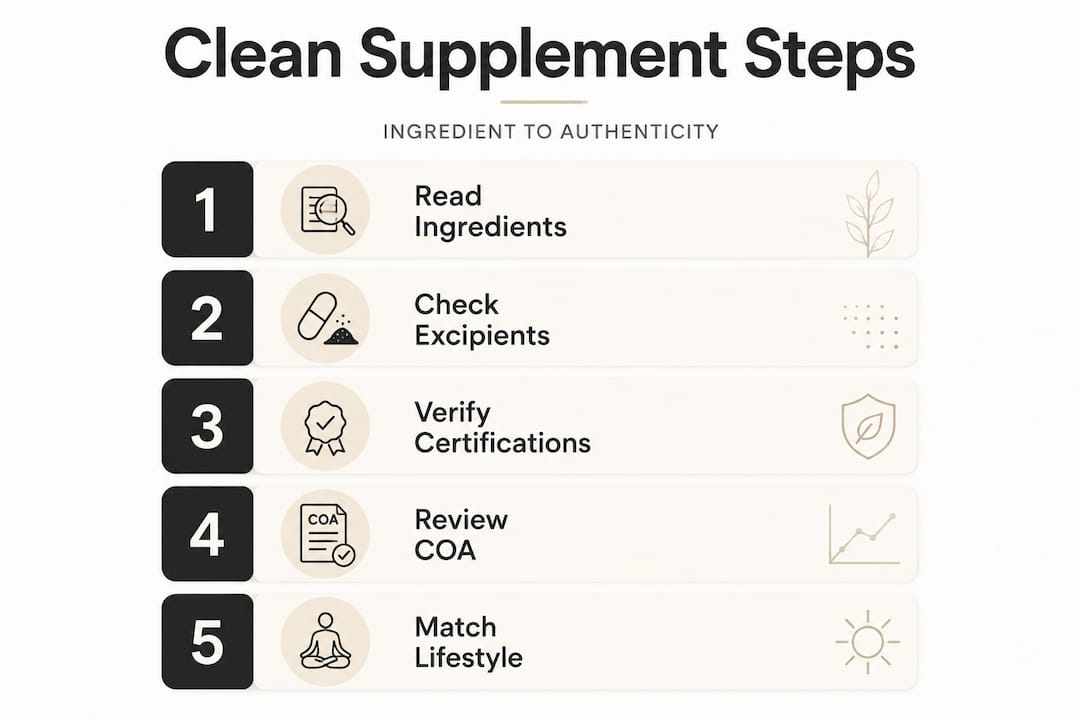
Here's how to verify clean status step by step:
- Check for a third-party seal on the label. Look for NSF, USP, Informed Sport, or Banned Substances Control Group (BSCG).
- Visit the certifying body's website and search for the brand or product to confirm the certification is current and legitimate.
- Review the brand's manufacturing claims. Look for "made in an FDA-registered, GMP-certified facility" on their website, not just the label.
- Request a Certificate of Analysis (COA). Reputable brands will share batch-specific lab results showing potency, purity, and absence of heavy metals or microbial contamination.
- Cross-reference with independent review sites like ConsumerLab, which conducts its own comparative testing across brands.
- Look at our third-party standards at our process page to understand what rigorous verification actually looks like in practice.
You can also browse vegan supplement reviews from brands that publish their testing data openly, which is one of the clearest signals of trustworthiness.
NSF Certified for Sport screens 290+ substances, making it the gold standard for contamination testing. If a brand carries this mark, it has passed one of the most thorough independent reviews in the industry.
Pro Tip: Match certifications to your specific lifestyle. If you're a vegan athlete, you need both a vegan-certified capsule AND a contamination-screening certification like Informed Sport. One without the other leaves gaps in your verification.
Once you know how to verify quality, it's important to apply these tools to vegan and holistic supplement choices.
Apply a clean label workflow to vegan and holistic supplements
Knowing the theory is one thing. Applying it to your actual shopping routine is another. Vegan 'clean' supplement selection should use ingredient simplicity, excipient screening, and third-party testing. A vegan label alone is not a quality guarantee.
Here's a practical workflow you can use every time you evaluate a new supplement:
- Start with the front label. Note any certifications (vegan, non-GMO, organic). These are starting points, not endpoints.
- Flip to the full ingredient list. Identify active ingredients, then scan "other ingredients" for excipients and processing aids.
- Flag any synthetic or animal-derived excipients. Use the list from the previous section as your reference.
- Search for third-party certification seals. Cross-check on the certifier's website to confirm validity.
- Request or download the COA. Confirm potency matches label claims and that heavy metals and contaminants are within safe limits.
- Evaluate the brand's transparency. Do they publish sourcing information? Do they explain why each ingredient is included? Are they forthcoming about their manufacturing standards?
- Apply your personal wellness criteria. For ancient plant traditions, look for whole-food sourcing and minimal processing. For adaptogens and mushrooms, look for dual-extraction methods and standardized active compounds.
Use this final checklist before any purchase through your vegan essentials workflow:
- Is the capsule plant-based (HPMC or pullulan, not gelatin)?
- Are all excipients plant-derived or mineral-based?
- Is there a verifiable third-party certification?
- Does the brand publish COAs or lab results?
- Are the active ingredients standardized to known potency levels?
- Is the product free from artificial colors, sweeteners, and preservatives?
- Is the sourcing of botanicals and adaptogens disclosed?
Special note for those integrating ancient traditions into modern routines: many adaptogenic herbs like ashwagandha, reishi, and tulsi have centuries of use behind them. But the quality of the extract matters enormously. A low-quality ashwagandha extract may contain very little withanolide (the active compound), while a standardized extract guarantees a specific percentage. This is where clean labeling and third-party testing work together to protect your investment and your health.
Why clean supplements require more than branding: our take
Here's something most supplement guides won't say plainly: the wellness industry has a branding problem. Beautiful packaging, plant-forward aesthetics, and terms like "pure," "whole," and "ancient" are powerful signals that can override critical thinking. We've seen it repeatedly. A product looks clean. It uses earthy tones and minimalist design. It mentions adaptogens and mushrooms. And yet, buried in the ingredient list, there's carrageenan, titanium dioxide, or a synthetic flow agent that has no place in a truly holistic product.
The gap between branding and reality is widest when it comes to excipients. Most clean supplement guides focus on active ingredients and skip over the "other ingredients" section. But plant-based excipients can vary in quality and contaminant risk, so verification still matters even when a product looks impeccably natural on the surface.
What we believe, based on years of formulating and sourcing, is that clean supplement selection is a practice, not a purchase. It requires the same intentionality you bring to food, to movement, to rest. You wouldn't eat food without knowing where it came from. Your supplements deserve the same scrutiny.
The brands worth trusting are the ones that make verification easy. They publish COAs. They explain their excipient choices. They name their suppliers. They welcome your questions. This kind of radical transparency is what our clean wellness philosophy is built on, and it's what we believe every brand in this space should aspire to.
Pro Tip: Always verify excipients, even in plant-based products. "Vegan" tells you what's not in the product (animal derivatives). It says nothing about synthetic additives, contaminant risk, or potency accuracy.
If you want to go further, explore our curated wellness collections to see how ingredient transparency and ritual-based self-care can work together in a daily practice.
Where to find clean, vegan supplement options
Applying these standards to every supplement you buy takes time, especially when you're starting from scratch. That's why curated collections built around these exact criteria can be a meaningful shortcut.

At SACRAHAUS, every product in our lineup is third-party tested, non-GMO, and made in the USA, with plant-based capsules and clearly disclosed ingredient sourcing. Whether you're looking for daily ritual support through vegan gummies supplements, functional nutrition through vegan supplement powders, or gut and skin support through probiotic and greens supplements, each collection is built to meet the verification standards outlined in this guide. You don't have to compromise between clean ingredients and effective formulas. Both are possible, and they're what we've built our entire brand around.
Frequently asked questions
Are 'clean' supplements always better for health?
Not always. Clean label isn't regulated, so a "clean" claim needs to be backed by third-party verification and accurate labeling to genuinely support better health outcomes.
How can I check if a supplement is third-party tested?
Look for seals from NSF, USP, or Informed Sport on the label, then confirm the certification is active on the certifying body's website. Third-party programs targeting label accuracy and contaminants are the most reliable indicators.
What are common hidden ingredients in vegan supplements?
Excipients, processing aids, and artificial sweeteners are often present even in vegan-labeled products. Excipients and processing aids matter in clean vegan supplements, so always review the full ingredient list, not just the Supplement Facts panel.
Does a vegan label guarantee holistic, clean ingredients?
No. Vegan supplement selection should use ingredient screening and third-party verification because a vegan label confirms the absence of animal products but says nothing about synthetic additives, excipient quality, or potency accuracy.
Where can I find unbiased supplement reviews?
Independent labs like ConsumerLab provide third-party reviews and comparative tests for purity, potency, and label accuracy across a wide range of supplement brands and categories.