
TL;DR:
- Certified vegan labels are verified by independent organizations confirming that products contain no animal ingredients or testing, ensuring genuine cruelty-free status. These standards involve rigorous ingredient screening, manufacturing controls, and annual renewal processes, unlike unregulated "vegan" claims. Consumers must check product-specific certifications and renewal dates to make informed, ethical purchases confidently.
Plenty of products on store shelves carry the word "vegan" in bold type, and most shoppers take it at face value. Here is the problem: that word is completely unregulated. Any brand can print it without a shred of outside verification. Understanding what is a certified vegan label is the single most important skill you can develop as a health-conscious consumer, because it separates products that have genuinely passed independent scrutiny from those riding a marketing trend. This guide breaks down what the label actually means, who grants it, and how to use that knowledge every time you shop.
Table of Contents
- What does certified vegan label mean and who certifies it?
- How certified vegan standards ensure product integrity and consumer trust
- Certified vegan vs plant-based: understanding key differences
- How to apply certified vegan labeling knowledge to your supplement choices
- Reconsidering vegan certification: what most consumers overlook
- Explore certified vegan supplements and wellness products at SACRAHAUS
- Frequently asked questions
Key Takeaways
| Point | Details |
|---|---|
| Certified vegan requires third-party verification | Only certified vegan labels verified by organizations ensure products exclude animal ingredients and testing. |
| Certification involves strict standards and ongoing review | Annual renewals and manufacturing safeguards maintain product integrity and consumer trust. |
| Certified vegan differs from plant-based claims | Plant-based can contain animal products or testing; certified vegan means fully cruelty-free. |
| Certification applies to individual products | Not all products from a brand may be certified; look for the certified vegan logo on each item. |
| Consumers should verify allergy concerns | Certifications minimize but do not guarantee zero cross-contamination; check with manufacturers if sensitive. |
What does certified vegan label mean and who certifies it?
To understand why certified vegan labeling matters, we first need to know what the label officially means and who grants it.
A certified vegan label is a third-party certification verifying that a product contains no animal ingredients or by-products and was not tested on animals at any stage of production. The key word is third-party. That means an organization with no financial stake in the product's sales reviewed the formulation, ingredients, and manufacturing process before approving the logo.
Compare that to a standard "vegan" claim on packaging. There is no government body, no minimum standard, and no required documentation behind it. A brand can label something vegan because it contains no meat, while the capsules are made from gelatin, or the product was tested on animals overseas. Certified vegan products carry proof. Self-declared vegan products carry a promise.
The major organizations that run vegan certification programs include:
- Vegan Action (Certified Vegan logo): One of the most recognized certifiers in the United States, reviewing ingredients and processes across food, supplements, cosmetics, and more.
- The Vegan Society (Vegan Trademark): A UK-based certifier whose vegan trademark standards exclude all animal-derived ingredients and testing, recognized globally.
- The Vegetarian Society (Vegan Approved trademark): A trusted European certifier with rigorous criteria for both ingredients and production.
- NSF International: A public health organization that has expanded into vegan and cruelty-free certification with particularly strong protocols for dietary supplements.
"Certified vegan" is not a marketing choice. It is a legal commitment to a documented standard, enforced by an outside authority that can revoke the logo if a product falls short.
When you see the certified vegan logo on a SACRAHAUS product or any other brand's item, you are looking at the output of a formal review process, not a copywriter's decision. Exploring curated wellness collections with this understanding changes how you evaluate every label you pick up.
How certified vegan standards ensure product integrity and consumer trust
With these strict standards and oversight, certified vegan labels build consumer trust by ensuring true vegan and cruelty-free status.

The criteria behind any credible certification go well beyond a simple ingredient check. Certified vegan products must exclude all animal ingredients, avoid animal testing at every stage, and implement safeguards against cross-contamination during manufacturing. That last point matters more than most people realize.
Here is a breakdown of what those standards typically cover:
- Ingredient exclusions: No meat, poultry, seafood, dairy, eggs, honey, beeswax, lanolin, gelatin, carmine, or any other animal-derived substance.
- Animal testing prohibition: Neither the finished product nor any of its individual ingredients can be tested on animals. Unlike some cosmetic regulations, most vegan certifications do not use cut-off dates; the ban is absolute.
- Cross-contamination controls: Shared manufacturing equipment can transfer trace animal ingredients. Certifiers require documented cleaning protocols and, in some cases, dedicated equipment.
- Supplier verification: Every ingredient supplier must provide documentation proving vegan compliance up the supply chain.
- Annual renewals: Ongoing compliance monitoring means companies must resubmit documentation every 12 months. A logo you see today reflects a recent review, not a one-time approval from years ago.
For supplement brands specifically, the bar is even higher. NSF's vegan certification program involves facility documentation and continuous technical review because capsule shells, excipients (inactive binding ingredients), and carriers are common hidden sources of animal ingredients.
| Standard | What it covers | Who enforces it |
|---|---|---|
| No animal ingredients | Full formulation review | Third-party certifier |
| No animal testing | Ingredients and final product | Third-party certifier |
| Cross-contamination controls | Manufacturing safeguards | Facility audit or documentation |
| Annual renewal | Continued compliance | Recertification review |
| Supplier documentation | Upstream ingredient sourcing | Applicant with certifier oversight |
Pro Tip: When reviewing a supplement's vegan credentials, look specifically for language about capsule composition. Many brands switch to vegan HPMC (hydroxypropyl methylcellulose) capsules and document it on their product pages. If a brand is silent on capsule type, ask.
You can learn more about our process for vegan certification to see what responsible documentation looks like in practice.
Certified vegan vs plant-based: understanding key differences
Understanding these differences sharpens your ability to identify genuinely vegan products.
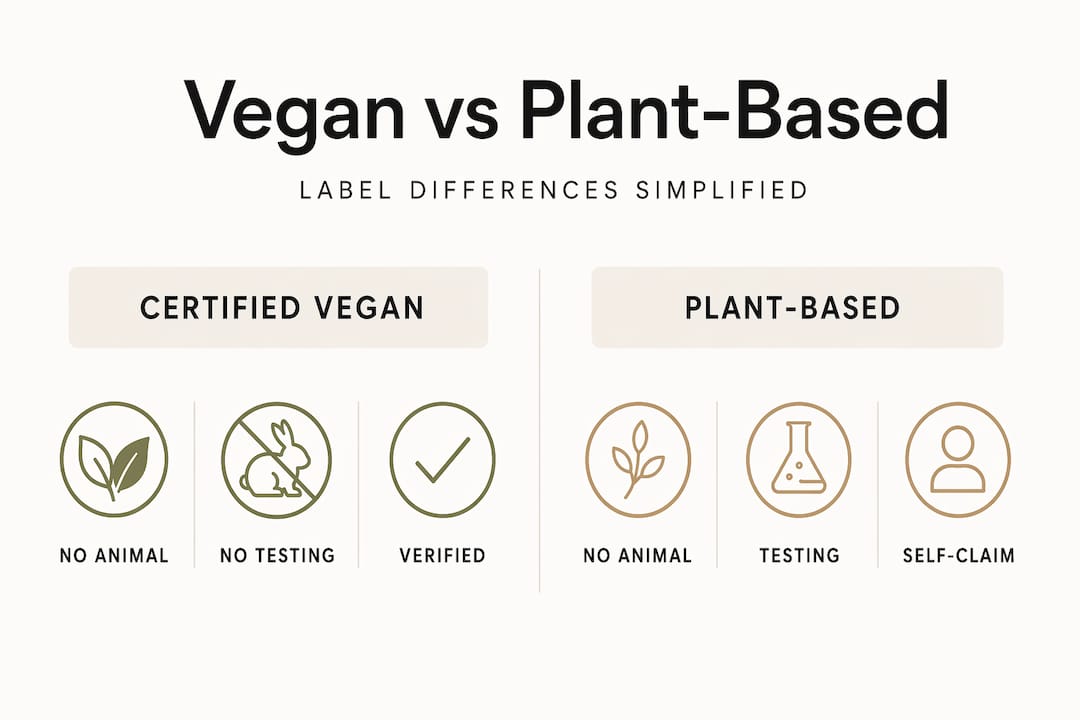
"Plant-based" is one of the most misunderstood labels in wellness retail. It sounds synonymous with vegan, but it is not. Plant-based products may still contain animal ingredients or be animal-tested, unlike certified vegan products. The term describes an intention or a general formulation direction, not a verified standard.
Here is the practical distinction:
- Plant-based: A manufacturer's claim that the product leans on plant-derived ingredients. There is no third-party check, no animal testing prohibition required, and no standard minimum. A product could contain milk derivatives and still be marketed as "plant-based."
- Certified vegan: A third-party verified commitment that zero animal ingredients are present and zero animal testing occurred, confirmed by an independent organization.
| Label | Animal ingredients excluded | Animal testing excluded | Third-party verified |
|---|---|---|---|
| "Plant-based" | Not required | Not required | No |
| "Natural" | Not required | Not required | No |
| "Vegan" (self-declared) | Brand's claim only | Brand's claim only | No |
| Certified vegan | Yes, confirmed | Yes, confirmed | Yes |
This distinction is especially important for people choosing products based on ethical values, not just dietary ones. If cruelty-free matters to you, "plant-based" alone does not get you there.
The SACRAHAUS clean wellness philosophy is grounded in exactly this kind of specificity. Vague claims belong in a different category from verified standards, and the gap between the two is where your health and your values are either honored or quietly ignored.
It is also worth noting that cosmetic and supplement labeling operate under different regulatory frameworks, which is part of why understanding the difference between cosmetic and vegan labeling helps consumers navigate multi-category wellness brands with confidence.
How to apply certified vegan labeling knowledge to your supplement choices
Now that you can distinguish and understand certified vegan labels, let us explore a wider perspective on their value and practical nuances.
Knowing the theory is one thing. Using it in real purchasing decisions is another. Here is a practical process for putting vegan certification knowledge to work every time you buy supplements, beauty products, or wellness staples.
-
Look for the logo first. Vegan Action's Certified Vegan sunflower logo, The Vegan Society's trademark, and NSF's certification mark are the most common. They should be visible on the product packaging or the product page. No logo means no independent verification.
-
Verify the specific product, not just the brand. Certification applies to individual products, not entire companies. A brand may have some certified products and others that are not. Do not assume brand-level certification exists.
-
Check renewal transparency. Responsible brands publish or make available their certification documentation. If a brand cannot tell you when their certification was last renewed, treat that as a flag worth noting.
-
Review cross-contamination language. Consumers with allergies should verify manufacturing processes even with certification, because some certifiers allow trace cross-contamination in facilities that also process animal-derived ingredients. If you have a severe allergy, call the manufacturer directly.
-
Prioritize supplement-specific certifications. For dietary supplements, certifiers like NSF have protocols designed specifically for the complexity of supplement manufacturing. A cosmetic certification does not carry the same weight for an ingestible product.
Pro Tip: Build a short mental checklist: certified logo, product-level certification, capsule type disclosed, and cross-contamination policy available. A supplement brand that checks all four is operating with real transparency.
When shopping for vegan supplement essentials or vegan beauty products, use this checklist actively rather than relying on the overall aesthetic or price point of a brand. Premium packaging and a clean aesthetic are not the same as verified ethical production.
Reconsidering vegan certification: what most consumers overlook
Most guides on vegan certification stop at explaining what the label means. That leaves out the part that actually protects you as a buyer.
The single most common misunderstanding is thinking that if one product from a brand is certified vegan, the entire catalog is. That is not how it works. Certification covers individual products, not companies or brands. A supplement brand could have a certified protein powder and a non-certified vitamin formula sitting side by side on the same shelf. You have to check each item separately.
The second thing most people miss is the difference between certifiers who do a one-time review and those who require annual renewal. Continuous oversight and annual renewals are what separate certifiers who maintain integrity from those who performed a check years ago and never followed up. Reformulations happen. Suppliers change. Facilities shift production. A certification without renewal has an expiration date in everything but name.
Then there is the cross-contamination question. Allowing trace cross-contamination is a policy some certifiers adopt to make certification accessible to more manufacturers, particularly those in shared facilities. That is a reasonable trade-off for expanding the supply of certified vegan products overall. But if you have severe allergies to dairy, eggs, or shellfish, it is a detail that matters directly to you, and "certified vegan" does not automatically mean "safe for your allergen profile."
Finally, the supply chain work behind a certified vegan label is invisible to most shoppers but is where the real rigor lives. Every ingredient, every excipient, every capsule shell, every carrier oil has to trace back to a verified non-animal source. That is a substantial operational commitment, not just a marketing one. Brands doing it seriously often share that transparency in how they describe their products. You can see that kind of attention in the approach behind beauty ritual vegan certification, where ingredient sourcing is part of the story, not an afterthought.
The vegan label on a product is the tip of the iceberg. What sits underneath it is a supply chain audit, manufacturing controls, documentation reviews, and annual accountability. Consumers who understand that ask better questions and make purchases they do not have to second-guess.
Explore certified vegan supplements and wellness products at SACRAHAUS
You now have the framework to evaluate vegan labels the way an industry insider would. The next step is finding products that actually meet that standard.
SACRAHAUS was built for exactly this kind of consumer. Every product in the vegan essentials supplements collection is formulated without animal-derived ingredients, and production transparency is built into how the brand operates. The full range of vegan vitamins and supplements spans adaptogens, botanicals, functional mushrooms, and targeted wellness formulas, all third-party tested and made in the USA. For those who extend their values into daily rituals, the vegan beauty products collection brings the same ethical standards to what goes on your skin. Every product page gives you the details you need to shop with real confidence, not just good intentions.
Frequently asked questions
What is the difference between 'certified vegan' and just 'vegan' on product labels?
Certified vegan means a trusted third-party verified the product has no animal ingredients or testing, while "vegan" alone is a manufacturer's unverified claim. Since "vegan" is unregulated, any brand can use the word without meeting any defined standard.
Do certified vegan labels guarantee no cross-contamination with animal products?
Most certifications require measures to minimize cross-contamination but may allow trace amounts in shared facilities. The Certified Vegan logo is not an allergen label, so consumers with specific sensitivities should verify manufacturing practices directly with the brand.
How often do certified vegan products need to be re-certified?
Certification is typically valid for 12 months. Annual renewal requires updated documentation and review, ensuring the logo reflects current formulation and production practices rather than a one-time historical check.
Does certified vegan apply to companies or individual products?
Certification applies to individual products only, not entire brands or manufacturers. Each product must be approved separately, so checking the specific item rather than assuming brand-wide status is essential.
Are certified vegan labels relevant for dietary supplements?
Yes, and the standards for supplements are often stricter than for food or cosmetics. NSF's vegan certification protocol applies specifically to dietary supplements with ongoing compliance monitoring to account for the complexity of supplement ingredient sourcing and manufacturing.