
TL;DR:
- A ritual ladder is a knotted cord used to store and gradually release spiritual intentions through focused practice. Its knots symbolize goals or affirmations, enhancing meditation, manifestation, and personal growth by creating a physical record of intentions.
A ritual ladder is defined as a knotted cord or rope used to store and gradually release spiritual intention through focused, deliberate practice. Also called a witch's ladder in folk magic traditions, this tool has roots in centuries-old knot magic and serves as a physical anchor for manifestation, meditation, and personal growth. The ritual ladder meaning extends well beyond decoration. Each knot holds a specific goal, emotion, or affirmation, making the cord a tactile record of your intentions. Sacrahaus draws on this ancient practice to frame modern wellness rituals that connect mind, body, and spirit.
What is a ritual ladder, and where does it come from?
A ritual ladder is a cord tied with intentional knots to store and slowly release magical or spiritual intention. Common knot counts are 3, 7, 9, 13, and 40, with cord lengths typically running 3 to 9 feet. The 40-knot version is used specifically for extended meditation practice. That range of options shows how flexible the tool is across different traditions and goals.
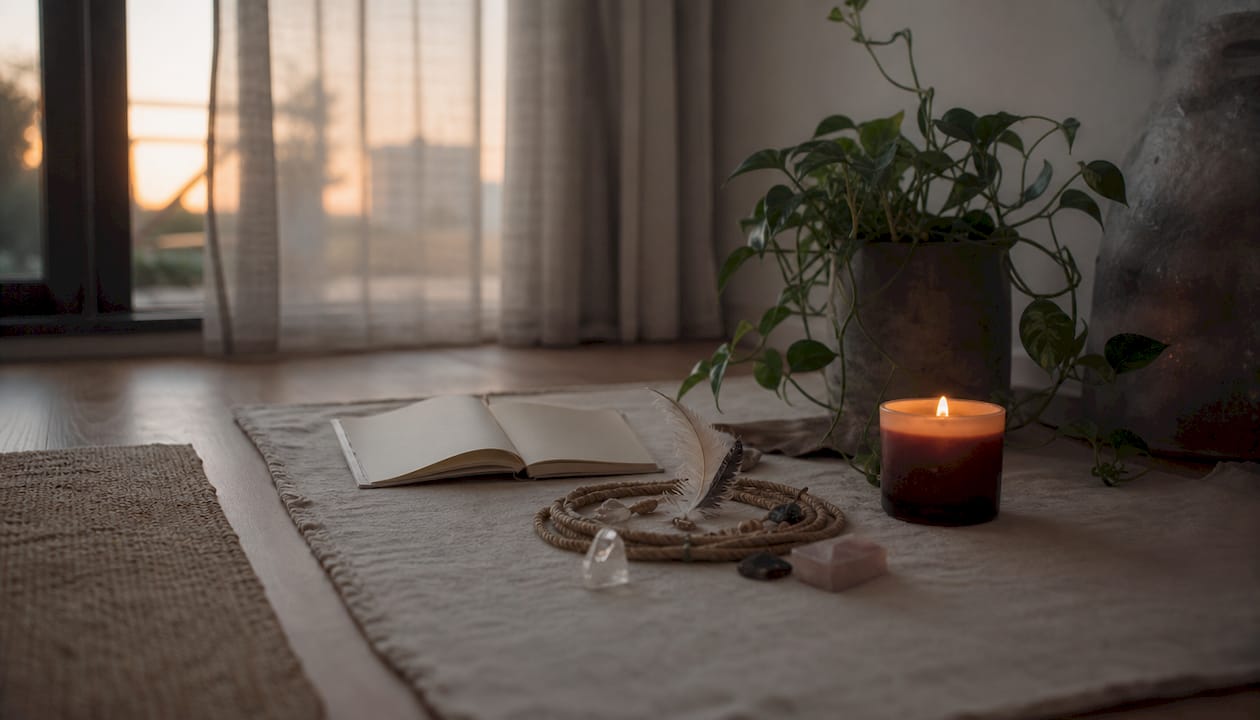
The term "witch's ladder" entered the written record in the 19th century, but the underlying practice of knot magic is far older. Sailors tied knots in ropes to hold wind. Healers knotted cords to bind illness. The ritual ladder formalizes that instinct into a structured, repeatable practice. What makes it distinct from a simple knotted string is the deliberate intention placed into each knot at the moment of tying.
The definition of a ritual ladder also carries a psychological dimension. Tying a knot while holding a clear mental image of your goal creates a physical cue that your mind can return to. Each time you touch the cord, you reconnect with that original intention. This is why the tool works as well in a modern wellness context as it did in traditional folk magic.
What are the components of a ritual ladder?
The physical materials you choose carry as much meaning as the knots themselves. Natural cords of cotton or wool are standard, and color plays a direct role in the ladder's purpose. Red supports vitality and protection, white brings clarity and purification, and black absorbs negativity. The original 19th-century witch's ladder braided all three colors together with nine feathers woven at each knot.
Beyond the cord, charms add specificity to the intention. Folk magic traditions include bones, feathers, crystals, and herbs as common additions. Each charm maps to a symbolic quality: feathers represent freedom or air energy, shells support emotional healing, and crystals amplify or focus specific energies. Choosing charms that resonate with your personal goal makes the ladder more effective as a meditation anchor.
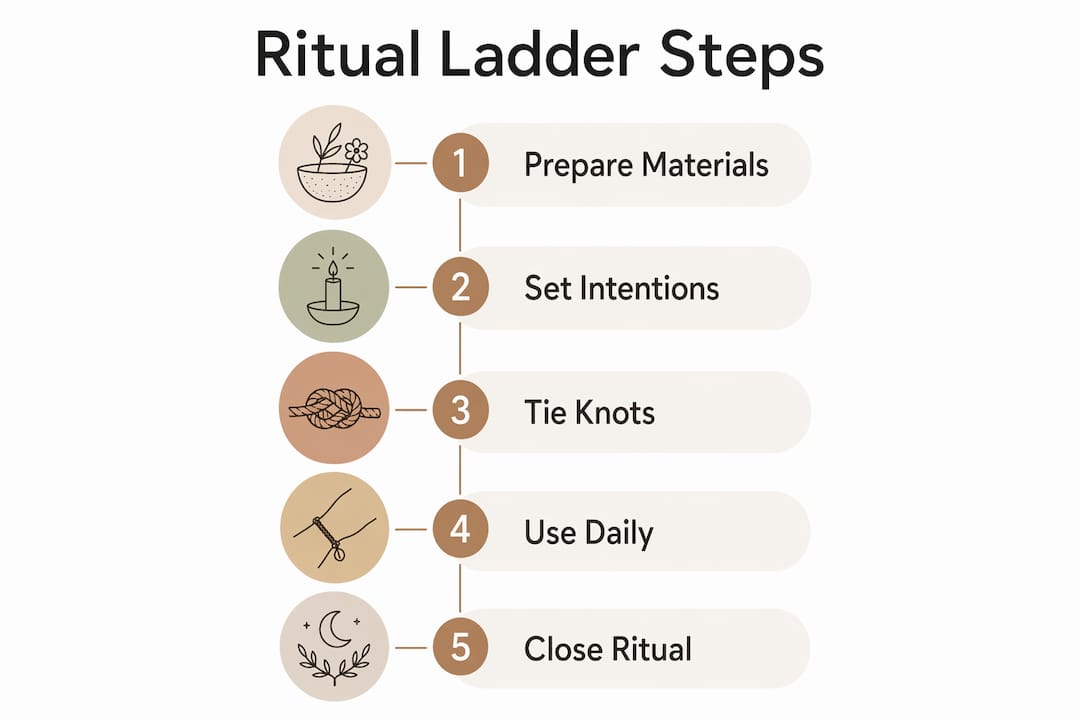
The crafting process follows a clear sequence:
- Set your intention. Write it down or speak it aloud before you begin. Clarity at this stage determines the quality of every knot that follows.
- Choose your cord and color. Match the color to your goal. Use natural fiber for best results.
- Select your charms. Pick feathers, beads, stones, or herbs that symbolize your specific intention.
- Tie each knot with focus. Chant, breathe, or visualize your goal as you tie. Each knot seals that moment of focus into the cord.
- Work non-sequentially. Tying the middle knot first and working outward is a standard technique. This non-sequential order protects the spell's energy from being easily undone.
Pro Tip: Write a short phrase or affirmation for each knot before you begin. Reading each phrase aloud as you tie keeps your focus sharp and prevents mental drift during the process.
Nine knots are favored because nine represents spiritual completion and the power of three repeated three times. That layered symbolism amplifies the ritual's potency. If nine feels like too many for a first practice, starting with three knots is a respected and effective alternative.
What does a ritual ladder symbolize spiritually?
The ladder as a spiritual symbol appears across cultures and centuries. Its most recognized form in Western tradition is Jacob's Ladder from the Hebrew Bible, where a ladder connects earth to heaven. The Hebrew word for ladder, "sulam," links numerically and symbolically to "semel," meaning "symbol." That linguistic connection suggests the ladder was always understood as a representation of something larger than its physical form.
The core symbolic meaning of a ritual ladder rests on movement, not position. The ladder does not represent where you are. It represents the act of climbing or descending. Each rung marks a step in spiritual growth or a challenge that requires you to dig deeper. This framing makes the ladder a useful mental model for personal development, where progress is measured in movement rather than arrival.
Key symbolic dimensions of the ritual ladder include:
- Vertical axis. The ladder connects the physical world below to the spiritual realm above, making it a bridge between two states of being.
- Ascending and descending. Going up represents growth, clarity, and expansion. Going down represents introspection, challenge, and the work of integration.
- Numeric symbolism. The number of knots carries meaning. Three represents the trinity of mind, body, and spirit. Nine signals completion. Thirteen connects to lunar cycles and transformation.
- Tactile memory. Each knot becomes a physical marker of a specific intention, creating a sensory map of your spiritual practice.
The focus is less on static spiritual status and more on the dynamic movement of ascending or descending the ladder's rungs. Progress in spiritual growth is not a destination. It is a direction.
The ladder symbolizes a pathway bridging heaven and earth, with each rung representing a step in growth or challenge. Visualizing your progress along those rungs gives your mind a concrete image to work with during meditation. That concreteness is what separates ritual ladder symbolism from abstract affirmation practice.
How do you use a ritual ladder in modern wellness?
A ritual ladder fits naturally into existing wellness routines because it requires no special setting or equipment. The cord itself is the practice. You can hold it during morning meditation, place it on a nightstand as a visual anchor, or incorporate it into a beauty ritual as a moment of mindful intention before skincare.
Practical applications include:
- Meditation anchor. Hold the cord and move through each knot as a tactile rosary. Each knot becomes a breath, an affirmation, or a moment of stillness.
- Manifestation tracking. Assign a specific goal to each knot. Revisit the cord weekly to assess your progress and recommit to each intention.
- Self-care integration. Place the ladder near your skincare or supplement routine as a reminder to approach those moments with full attention rather than autopilot.
- Intention release. When your goal is fulfilled, release the ladder by burning, burying, or casting it into running water. Simply discarding it can dissipate the stored energy without proper closure.
- Evening wind-down. Holding the cord during an evening ritual signals to your nervous system that the day's active phase is complete.
Pro Tip: Pair your ritual ladder practice with a consistent physical anchor, such as a specific chair, candle, or scent. Consistency trains your brain to enter a focused state faster each session.
The purpose of a ritual ladder in wellness is to make intention tangible. Abstract goals stay abstract. A knotted cord you can hold, touch, and see every day keeps your goals present in your physical environment. That daily contact is what builds the habit of intentional living.
How can you personalize a ritual ladder for your own practice?
No standard formula governs ritual ladder creation. Effectiveness depends on the creator's belief system, intentionality, and meditative state. This flexibility is the tool's greatest strength. You are not following a recipe. You are building a personal object that reflects your specific goals and values.
The table below shows how different variables can be adjusted to match your practice:
| Variable | Traditional Approach | Personal Adaptation |
|---|---|---|
| Knot count | 9 or 13 for completion | 3 for simplicity, 40 for deep meditation |
| Cord material | Cotton or wool, natural fiber | Any natural material that feels meaningful |
| Color | Red, white, black | Any color that resonates with your goal |
| Charms | Feathers, bones, shells, herbs | Crystals, personal tokens, dried flowers |
| Release method | Burning, burying, or water | Unraveling with gratitude, gifting, or keeping |
Combining a ritual ladder with other practices deepens its effect. Pairing it with breathwork, journaling, or a morning intention ritual creates a layered practice where each element reinforces the others. The ladder becomes one thread in a larger web of intentional living.
Handling the completion of a ladder deserves as much care as its creation. Ritual disposal through burning, burying, or casting into water closes the energetic loop properly. If your goal shifts before the ladder is complete, you can untie the knots one by one with the same focused intention used to tie them, consciously releasing each goal as you go.
Key Takeaways
A ritual ladder works because it converts abstract intention into a physical object you interact with daily, making consistent, focused practice far more likely than mental affirmation alone.
| Point | Details |
|---|---|
| Core definition | A ritual ladder is a knotted cord used to store and release spiritual intention through deliberate practice. |
| Knot count matters | Common counts of 3, 9, and 13 each carry distinct symbolic meaning that shapes the ladder's purpose. |
| Materials carry meaning | Color, fiber type, and charms all contribute to the ladder's energetic focus and personal resonance. |
| Release is required | Burning, burying, or casting into water properly closes the ritual when a goal is fulfilled. |
| Personalization is the point | No fixed formula exists; the ladder's power comes from the creator's belief and intentional focus. |
What I've learned from treating ritual ladders as spiritual resistance training
Most people approach a ritual ladder as a one-time craft project. That misses the real value. The act of tying each knot with full attention is a form of mental training. Repetitive, focused knot-tying strengthens cognitive and spiritual focus over time, in the same way that physical resistance builds muscle. The ladder is not the destination. The practice of making it is.
What I find most compelling about this tool is its tactile honesty. You cannot fake a knot tied with intention. Either you were present at that moment or you were not. The cord holds a record of your actual attention, not your aspirational attention. That accountability is rare in wellness practice, where it is easy to go through the motions without genuine engagement.
The visual and tactile engagement of a ritual ladder also solves a problem that purely mental practices cannot. Abstract affirmations fade. A physical object on your altar, nightstand, or desk does not. Every time you see it, your brain receives a subtle reminder of the intention it holds. That passive reinforcement compounds over weeks and months into a genuine shift in focus and behavior.
Ritual ladders also pair well with the kind of clean wellness philosophy that treats every daily habit as a conscious choice. When your supplements, your skincare, and your morning routine are all chosen with intention, a ritual ladder becomes a natural centerpiece. It is the physical expression of the same mindset that drives every other intentional choice you make.
— Sacrahaus
Ritual ladders and the Sacrahaus approach to intentional wellness
Ritual ladders are built on the same principle that guides everything at Sacrahaus: intention without action is incomplete. A knotted cord focuses your mind. Clean, plant-based nutrition supports the body that carries that mind through every practice. The two work together. Sacrahaus vegan supplements and gummies are formulated with adaptogens, botanicals, and mushrooms to support the energy, focus, and calm that intentional practice demands. If your ritual ladder is tied to goals around clarity, sleep, or vitality, pairing it with a targeted supplement protocol gives your body the physical foundation your practice needs. Explore the full vegan supplement collection to find what fits your current intentions.
FAQ
What is a ritual ladder in simple terms?
A ritual ladder is a knotted cord used to hold and slowly release a specific intention or goal through focused, deliberate practice. Each knot stores a moment of concentrated thought, visualization, or affirmation.
How many knots does a ritual ladder have?
Common knot counts are 3, 9, and 13, with 40-knot versions used for extended meditation. Nine is the most traditional count because it represents spiritual completion.
What materials do you need to make a ritual ladder?
Natural fiber cords in red, white, or black are standard, along with charms such as feathers, crystals, shells, or herbs. Each material is chosen to match the symbolic quality of your specific intention.
How do you properly end a ritual ladder practice?
Burn, bury, or cast the cord into running water once your goal is fulfilled. This closes the energetic working and prevents the stored intention from dissipating without proper release.
Can anyone make a ritual ladder?
Yes. No fixed formula governs the process, and the ladder's effectiveness depends on the creator's personal belief and intentional focus rather than adherence to a specific tradition.