
TL;DR:
- A supplement stack is a goal-driven combination of supplements designed to achieve specific health outcomes through synergy and structured protocols. Proper stacking involves defining clear goals, selecting proven complementary supplements, and auditing ingredient overlaps to avoid risks like nutrient doubling or side effects. Building a successful stack starts with simple, tested components, careful timing, and ongoing assessment for measurable results.
A supplement stack is defined as a goal-driven combination of supplements with specific ingredients, doses, timing, and feedback loops working together toward a measurable health outcome. The key word is "intentional." A stack is not a drawer full of random capsules. It is a structured protocol with defined components: a clear health goal, testable outcomes, risk-aware constraints, and a plan to revise what is not working. The concept of synergy sits at the heart of every effective stack. When two or more supplements enhance each other's absorption or effects, the combined result exceeds what either could achieve alone. Understanding what a supplement stack is, and how to build one correctly, is the difference between spending money wisely and wasting it.
What is a supplement stack and why does synergy matter?
Synergy is the scientific reason stacking works better than taking a single supplement in isolation. When nutrients interact positively, the body absorbs and uses them more efficiently. Vitamin D3 supports calcium absorption, and magnesium acts as a cofactor that activates Vitamin D in the body. Take either one alone and you get a partial effect. Take them together and each amplifies the other.
The same principle applies across wellness goals. Athletes use creatine, protein, and beta-alanine together because each targets a different mechanism: creatine fuels short bursts of power, beta-alanine buffers muscle fatigue, and protein repairs tissue after training. No single ingredient covers all three. A well-designed stack fills those gaps without redundancy.
Single supplements still have value, but they work best when you have one specific, isolated deficiency. The moment your goal becomes more complex, such as improving energy, recovery, and immune function at the same time, a thoughtfully built stack becomes the more effective approach. The benefits of supplement stacking come from this targeted layering, not from taking more pills.
Pro Tip: Before adding a new supplement to your stack, write down the specific outcome you expect from it. If you cannot name a measurable result, you do not need it yet.
What are the risks and safety rules of supplement stacking?
The biggest danger in supplement stacking is not what you take. It is what you take twice without realizing it. Silent ingredient overlaps occur when caffeine, vitamin A, iron, zinc, or niacin appear in multiple products you are already using. The cumulative dose can cross into side-effect territory before you notice anything is wrong.
Fat-soluble vitamins like A, D, E, and K accumulate in body tissue rather than flushing out daily. Doubling up on these through multiple products is a genuine risk, not a theoretical one. Stimulants like caffeine carry the same concern. A pre-workout, an energy drink, and a fat-burner taken on the same day can push total caffeine well beyond a safe threshold.
The solution is a label audit before you start. Read every ingredient panel across every product you plan to use. Flag anything that appears more than once and calculate the combined dose. This takes 20 minutes and prevents weeks of troubleshooting.
Common risk factors to audit before building your stack:
- Stimulant overlap: caffeine appearing in pre-workouts, energy supplements, and fat-loss products simultaneously
- Fat-soluble vitamin excess: vitamin A or D from multiple sources adding up beyond safe daily limits
- Mineral competition: high-dose zinc blocking copper absorption when both appear in separate products
- Niacin stacking: niacin in a B-complex plus a separate energy formula can cause flushing and discomfort
- Iron sensitivity: iron supplements combined with high-vitamin-C products can increase absorption beyond what some people tolerate
Pro Tip: Start every new stack with just one or two supplements for the first two weeks. This makes it easy to identify which product is responsible if you notice any side effect.
How to create a supplement stack for your health goals
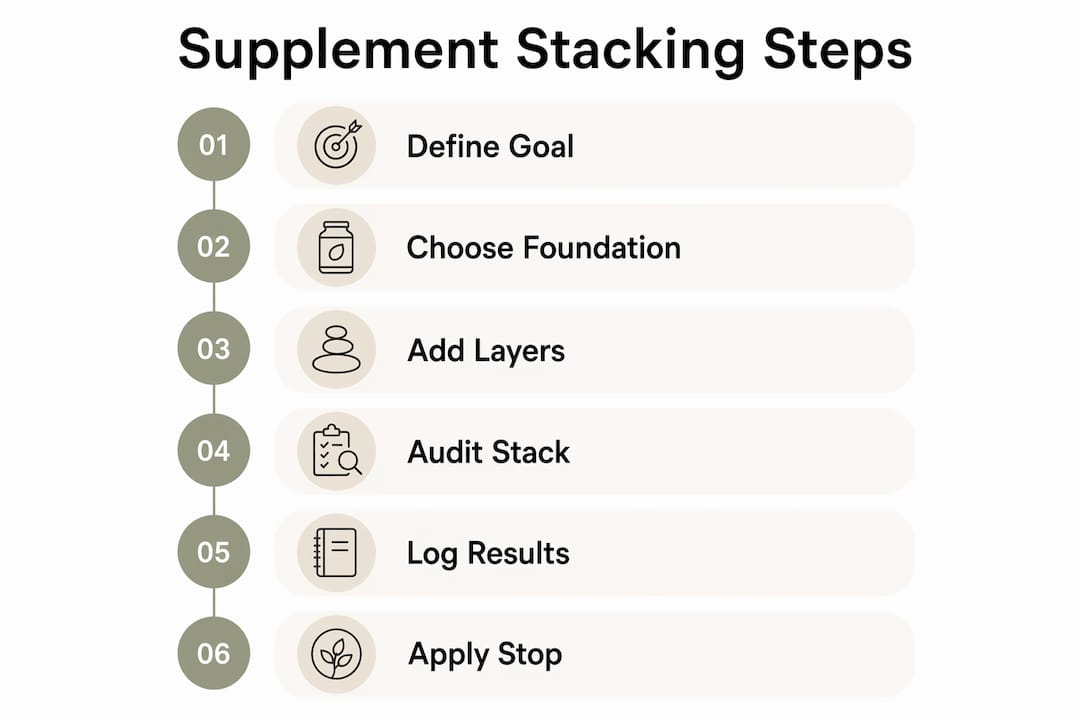
Building a supplement stack for beginners works best as a staged process. Rushing to a six-product protocol on day one is the fastest way to fail. Start simple, test honestly, and add only when the foundation is working.
Step 1: Define one specific goal
Write it down in one sentence. "I want more energy during afternoon work hours" is a goal. "I want to feel better" is not. Specificity determines which supplements belong in your stack and which do not.
Step 2: Choose one or two foundational supplements
Pick supplements with strong evidence for your goal and known synergy with each other. Beginners benefit most from starting with complementary pairs like Vitamin D3 with Vitamin K2, or magnesium with an evening adaptogen. These combinations are well-studied and low-risk.

Step 3: Add one to three goal-specific layers
Once your foundation is stable after two to four weeks, add supplements that address secondary gaps. If your goal is energy, you might add a B-complex or an adaptogen like ashwagandha after your base is established. Each addition should target a specific mechanism, not just a vague benefit claim.
Step 4: Audit for overlaps and interactions
Before adding anything new, compare its full ingredient list against everything already in your stack. Pay special attention to stimulants, fat-soluble vitamins, and minerals. This step takes five minutes and prevents most common stacking mistakes.
Step 5: Log your results
Track both objective markers (sleep quality scores, workout performance, energy levels on a 1–10 scale) and subjective feelings. A log does not need to be elaborate. A simple note on your phone works. Maintaining a tracking log is what separates a protocol from an expensive habit.
Step 6: Apply stop criteria
Every supplement in your stack needs a defined exit condition. If a supplement shows no measurable benefit after six to eight weeks, remove it. If it causes any side effect, remove it immediately. A dynamic, measure-based protocol treats stacking as an ongoing experiment, not a permanent commitment.
What are some effective supplement stacks for common wellness goals?
Practical examples make the theory concrete. These three stacks represent the most common wellness goals and show how synergy applies in real use.
Bone health stack
The classic bone health combination pairs Vitamin D3, Vitamin K2, and magnesium. Vitamin D3 drives calcium absorption from food. Vitamin K2 directs that calcium into bones rather than soft tissue. Magnesium activates Vitamin D at the cellular level. All three are required for the system to work correctly. Remove any one of them and the stack loses its core function.
Energy and endurance stack
Creatine, beta-alanine, and protein form the foundation of most performance-oriented stacks. Creatine replenishes ATP for short, intense efforts. Beta-alanine raises carnosine levels in muscle, delaying the burning sensation that forces you to stop. Protein provides the amino acids needed for muscle repair after training. Each targets a different phase of performance and recovery.
Immune support stack
Vitamin C, zinc, and echinacea address immune function from three angles. Vitamin C supports white blood cell production. Zinc is required for immune cell development and signaling. Echinacea has a long record of use for reducing the duration of upper respiratory infections. Together, they cover both the structural and reactive sides of immune defense.
The table below summarizes these common supplement stacks and their core rationale:
| Goal | Core supplements | Primary synergy |
|---|---|---|
| Bone health | Vitamin D3, K2, Magnesium | D3 absorption activated by magnesium; K2 directs calcium to bone |
| Energy and endurance | Creatine, Beta-alanine, Protein | ATP fueling, fatigue buffering, and tissue repair in sequence |
| Immune support | Vitamin C, Zinc, Echinacea | Cell production, immune signaling, and infection response |
| Sleep and recovery | Magnesium, Ashwagandha, L-theanine | Cortisol reduction, nervous system calming, and sleep depth |
Supplement forms also matter for adherence. Powders, gummies, and strips each suit different timing needs and lifestyle preferences. A powder works well pre-workout. A gummy fits a morning ritual. A strip is convenient for midday use without water.
How does timing affect supplement stack results?
Timing is the variable most people ignore, and it explains why two people using identical stacks get different results. Supplement timing and frequency directly affect how well combinations are absorbed and how effectively they interact in the body.
Fat-soluble vitamins like D3, K2, and A absorb best with a meal containing dietary fat. Taking them on an empty stomach reduces their bioavailability significantly. Water-soluble vitamins like C and B-complex absorb well at any time but are best taken earlier in the day to avoid interfering with sleep.
Workout-specific supplements follow a different schedule. Creatine is effective taken at any consistent time, though many people prefer post-workout. Beta-alanine works best split into smaller doses throughout the day to reduce the tingling sensation it can cause. Pre-workout stimulants should be timed 30–45 minutes before training and avoided within six hours of sleep.
Key timing principles for any stack:
- Take fat-soluble vitamins with your largest meal of the day
- Separate calcium and iron by at least two hours, as they compete for absorption
- Use calming supplements like magnesium and adaptogens in the evening
- Cycle stimulant-containing supplements with planned days off to prevent tolerance
- Audit cumulative doses across the full day, not just per serving
Cycling is also worth building into your protocol. Taking planned breaks from certain supplements, particularly adaptogens and stimulants, prevents the body from adapting and reduces the risk of dependency. A common approach is five days on, two days off, or three weeks on, one week off for longer cycles.
Key Takeaways
A supplement stack works because it combines ingredients with defined goals, tested synergies, and a structured protocol that you revise based on real results.
| Point | Details |
|---|---|
| Define before you stack | Write one specific health goal before choosing any supplement. |
| Start with two supplements | Begin with a proven synergistic pair and test for two to four weeks before adding more. |
| Audit for silent overlaps | Check every ingredient panel for duplicate stimulants, fat-soluble vitamins, and minerals. |
| Time supplements correctly | Take fat-soluble vitamins with food and calming supplements in the evening. |
| Use stop criteria | Remove any supplement that shows no measurable benefit after six to eight weeks. |
What I have learned from building supplement stacks the hard way
Most people approach supplement stacking the way they approach a grocery list. They see a benefit claim, add it to the cart, and repeat. After a few months, they have eight products, no clear results, and no idea which one is actually doing anything.
The shift that changes everything is treating your stack as an engineering problem. You define the outcome first. You select the minimum number of inputs needed to reach it. You test, measure, and cut what does not perform. This is not complicated, but it requires discipline that most wellness marketing actively discourages.
I have also seen how much lifestyle factors shape stack outcomes. Environment, sleep quality, and stress levels determine whether a supplement has the biological conditions it needs to work. A magnesium supplement will not fix a sleep problem caused by screen exposure at midnight. The stack supports the lifestyle. It does not replace it.
The stacks I find most reliable are built around plant-based phytonutrients that support metabolic balance rather than aggressive stimulation. Adaptogens, mushrooms, and botanicals work with the body's existing systems rather than overriding them. They are slower to show results, but those results tend to hold. That is the kind of stacking worth building a ritual around.
— Sacrahaus
Build your stack with Sacrahaus vegan supplements
Sacrahaus designs every product with stacking in mind. Each formula is third-party tested, non-GMO, and made in the USA, so you know exactly what you are adding to your protocol.

The Vegan Essentials collection covers foundational nutrients including iron, magnesium, creatine, and greens, the building blocks most stacks need first. For energy and endurance goals, the Superpowders range offers clean, plant-based formulas that fit naturally into a pre-workout or morning ritual. Gummies and strips make timing easier without the need for measuring or mixing. Every product is built to work alongside others, so you can build a stack that is clean, purposeful, and genuinely yours.
FAQ
What is a supplement stack in simple terms?
A supplement stack is a planned combination of two or more supplements taken together to achieve a specific health goal. The supplements are chosen because they work better together than they would individually.
How many supplements should a beginner stack?
Beginners should start with one or two complementary supplements and add more only after testing the foundation for two to four weeks. Starting with too many products at once makes it impossible to identify what is helping or causing side effects.
What are the best supplement combinations for energy?
Creatine, beta-alanine, and protein form a well-supported energy and endurance stack. For general daily energy, B-complex vitamins paired with an adaptogen like ashwagandha address both cellular energy production and stress-related fatigue.
Can supplement stacks cause side effects?
Yes, particularly when ingredient overlaps go undetected. Silent overlaps in stimulants like caffeine or fat-soluble vitamins like A and D can cause cumulative side effects. Auditing every ingredient label before building your stack prevents most of these issues.
How long does it take to see results from a supplement stack?
Most well-designed stacks show measurable results within four to eight weeks. Fat-soluble vitamins and adaptogens often take longer than water-soluble nutrients. If a supplement shows no benefit after six to eight weeks, remove it from your protocol.