
TL;DR:
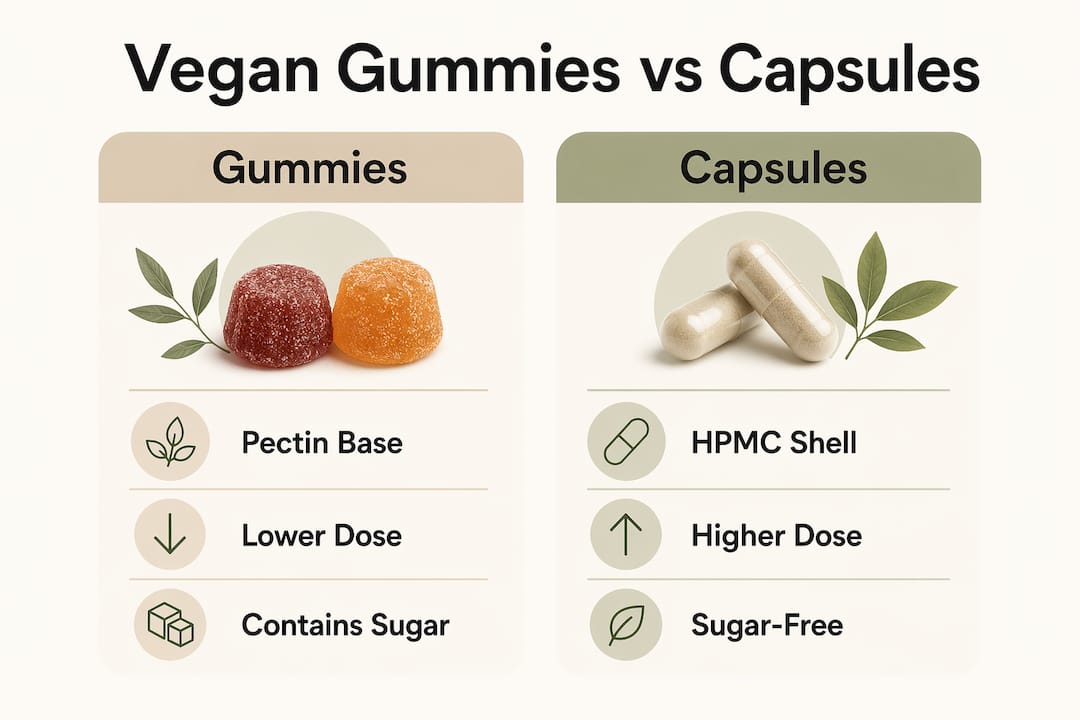
- Vegan gummies use plant-based gelling agents, while vegan capsules typically contain HPMC shells. Capsules offer higher dose capacity and better stability, whereas gummies excel in taste and compliance. Always verify ingredient lists and third-party vegan certification to ensure vegan standards.
Vegan gummies are chewable supplements made with plant-based gelling agents like pectin or agar-agar, while vegan capsules enclose powdered or liquid nutrients inside plant-derived shells, most commonly hydroxypropyl methylcellulose (HPMC). The choice between these two delivery forms, a comparison often called "vegan gummies vs capsules explained" in wellness circles, directly affects dosing accuracy, ingredient stability, and how well a supplement fits your daily routine. Sacrahaus formulates both forms with third-party tested, non-GMO ingredients made in the USA, which means the format question is worth taking seriously before you buy.
What are the ingredient and manufacturing differences between vegan gummies and capsules?
The gelling agent defines a vegan gummy. Conventional gummies use gelatin, which comes from animal collagen. Vegan versions replace it with pectin (derived from citrus peel or apple pomace), agar-agar (from red algae), or carrageenan (from seaweed). Each agent produces a different texture: pectin gummies are softer and more transparent, agar-agar gummies are firmer, and carrageenan gummies sit somewhere in between.

Heat stability separates these agents in a meaningful way. Pectin melts at lower temperatures than gelatin, which creates real shipping and storage risks in warm climates. Vegan gummies face melting risks during transit that capsules simply do not. That single fact explains why many high-potency formulas default to capsules for year-round reliability.
Capsule shells tell a different story. HPMC capsules are fully plant-derived and resist moisture better than animal gelatin capsules. That makes them the right choice for probiotics, powdered botanicals, and moisture-sensitive adaptogens. Gelatin capsules, by contrast, provide a superior oxygen barrier, which matters for omega-3 oils and other oxidation-prone ingredients. The material choice is always driven by what is inside the capsule, not by a generic "plant-based is better" assumption.
Manufacturing complexity also differs sharply. Gummy production requires precise temperature control, humidity management, and mold-setting time. Capsule filling is faster, more consistent, and easier to scale. Those differences show up in cost: gummies typically cost more to produce per serving than capsules delivering the same active ingredient.
Pro Tip: When evaluating any vegan supplement, check whether the gelling agent or capsule shell is listed explicitly on the label. "Vegan" on the front panel does not always mean the coating or filler agents are free of animal derivatives.
| Feature | Vegan gummies | Vegan capsules |
|---|---|---|
| Gelling or shell material | Pectin, agar-agar, carrageenan | HPMC (hydroxypropyl methylcellulose) |
| Heat stability | Lower; melting risk above 77°F | High; stable across temperatures |
| Moisture resistance | Moderate | High (HPMC) |
| Oxygen barrier | Low | Moderate to high (gelatin superior for oils) |
| Manufacturing cost | Higher per serving | Lower per serving |
How do vegan gummies and capsules compare in dosage, sugar, and efficacy?
Dosing capacity is the clearest functional difference between the two forms. Vegan pectin gummies typically hold only 1–3g of active ingredients per piece due to mass and texture constraints. That ceiling means a gummy delivering a meaningful dose of magnesium or ashwagandha often requires eating multiple pieces, which also multiplies sugar intake.
Sugar content in gummies is a real trade-off. Standard gummies contain 28–32g of added sugar per serving, which can negatively affect blood sugar levels and dental health. For health-conscious consumers watching glycemic load, that number matters. Sugar-free alternatives exist, but sugar alcohols used as replacements can cause digestive discomfort and alter texture in ways that affect the experience. Neither option is without a trade-off.
Capsules carry no added sugar and no gelling matrix. A single standard capsule can hold 500mg to over 1,000mg of a concentrated active ingredient, depending on the formulation. That makes capsules the practical choice for supplements requiring precise, higher doses, such as iron, creatine, or concentrated mushroom extracts. The vegan digestive supplements guide from Sacrahaus illustrates how capsule-based formulas allow for more targeted dosing in gut health protocols.
Bioavailability is more nuanced. No medical evidence confirms that plant-based capsule shells improve absorption compared to gelatin capsules. Absorption depends on the active ingredient and how it is formulated, not the shell material. Gummies do offer one absorption advantage: chewing begins mechanical breakdown in the mouth, which can support faster onset for certain water-soluble nutrients like vitamin C or B vitamins. For fat-soluble nutrients, that advantage disappears.
Vegan gummies also require natural colorings and flavorings that can degrade faster than synthetic alternatives. That means shelf life and storage conditions matter more for gummies than for capsules, which are protected inside an opaque shell.
What ethical and dietary considerations separate vegan gummies from capsules?
A gummy labeled "fruit-flavored" is not automatically vegan. Gelatin, beeswax, and shellac are the three most common non-vegan ingredients hiding in conventional gummies. Gelatin provides the chew, beeswax coats the outside to prevent sticking, and shellac (also called confectioner's glaze) adds shine. All three come from animals.
Truly vegan gummies replace gelatin with pectin or agar-agar and use carnauba wax (from palm leaves) instead of beeswax. The label must list these substitutions explicitly. A product that simply omits gelatin from the front panel but uses shellac as a coating still fails the vegan standard.
Capsules carry fewer hidden risks, but cross-contamination during manufacturing is a real concern. Facilities that produce both gelatin and HPMC capsules can introduce trace animal-derived material. Third-party certification from organizations like the Vegan Society or NSF provides the most reliable confirmation that a capsule product meets vegan standards throughout the supply chain.
Pro Tip: Look for supplements that list every excipient, not just active ingredients. Fillers, flow agents, and coatings are where non-vegan materials most often appear without obvious labeling.
The ethical case for plant-based gelling agents goes beyond avoiding animal products. Pectin and agar-agar are renewable, low-impact ingredients. HPMC is synthesized from plant cellulose. Both routes avoid the environmental and welfare concerns tied to gelatin production, which is a byproduct of the meat and leather industries.
- Check the full ingredient list, not just the "Supplement Facts" panel
- Look for explicit vegan certification logos from recognized third-party bodies
- Confirm the coating and capsule shell material, not just the active ingredients
- Avoid products that list "natural flavors" without specifying the source
- Prioritize brands that publish their manufacturing standards and third-party test results
How do consumer preferences and practical factors shape the gummies vs capsules decision?
Gummies attract consumers through taste and habitual use, and that appeal is not trivial. Supplement compliance, meaning whether you actually take your supplement every day, is one of the strongest predictors of long-term benefit. A gummy that tastes like a Sacrahaus Cordyceps energy gummy is easier to build into a morning ritual than a capsule you have to swallow with water. For people who struggle with pill fatigue or have difficulty swallowing capsules, gummies remove a real barrier.
Capsules win on portability and discretion. A bottle of capsules travels well, does not melt in a gym bag, and does not require refrigeration for most formulas. They are also faster to take: no chewing, no flavor, no sugar. For consumers managing multiple supplements at once, capsules are easier to stack without flavor conflicts or added sugar accumulating across doses.
Stability during shipping is a practical concern that rarely appears on product pages. Gummies can fuse together, lose shape, or partially melt in transit during summer months. Capsules arrive intact regardless of temperature. If you order supplements online and live in a warm region, that difference affects what you actually receive.
The right form depends on the specific supplement and your goals:
- Choose gummies when taste compliance matters most, when the active dose is low (vitamins C, D, or B12), or when you are building a daily ritual around the experience of taking supplements
- Choose capsules when you need higher doses, when the formula contains heat-sensitive or oxidation-prone ingredients, or when you want zero added sugar and a clean label
- Consider capsules for adaptogens, mushroom extracts, and probiotics, where dose integrity and moisture protection directly affect results
- Consider gummies for children, older adults, or anyone with swallowing difficulties who would otherwise skip supplementation entirely
The plant-based beauty supplements guide from Sacrahaus covers how delivery form affects beauty-focused formulas specifically, which is worth reading if skin or hair supplements are part of your routine.
Key Takeaways
Capsules deliver higher doses with no added sugar, while gummies offer taste-driven compliance that keeps people consistent with their supplement routines.
| Point | Details |
|---|---|
| Dosing capacity | Capsules hold significantly more active ingredient per unit than gummies. |
| Sugar trade-off | Gummies add sugar to the formula; capsules deliver nutrients with no added sweeteners. |
| Vegan verification | Always check coatings and excipients, not just active ingredients, for hidden animal derivatives. |
| Stability and shipping | Capsules withstand heat and transit better than pectin-based gummies. |
| Compliance factor | Gummies improve daily consistency for people who dislike swallowing pills. |
What I've learned from formulating both forms
The wellness industry treats gummies as a marketing format and capsules as a clinical one. That framing is mostly accurate, but it misses something. The best supplement is the one you actually take every day. A capsule sitting in a drawer because you dread swallowing it delivers zero benefit, regardless of its superior dose integrity.
That said, I have seen too many consumers unknowingly trade efficacy for taste. A gummy delivering 200mg of an adaptogen when the research-backed dose is 600mg is not a supplement. It is a candy with a health claim on the label. The sugar load compounds the problem: if you are taking a gummy for immune support while consuming 10g of added sugar per serving, you are working against yourself.
The honest answer is that the form should follow the function. For foundational nutrients like vitamin D, B12, or zinc, where doses are modest and compliance matters most, gummies are a legitimate choice. For high-dose formulas, probiotics, or anything that degrades in heat or moisture, capsules are the right call. Sacrahaus builds both forms because the goal is always efficacy first, with the ritual and experience layered on top. The Sacra Flora vegan capsules and the adaptogen gummy range exist for exactly this reason: different goals, different forms, same commitment to clean ingredients.
One more thing: "plant-based" on a capsule or gummy label does not automatically mean better absorbed, more ethical, or more effective. Read the full ingredient panel. Demand third-party testing. The form is a delivery mechanism. What matters is what is inside it and whether it reaches your body intact.
— Sacrahaus
Sacrahaus vegan supplements in the form that fits your goals
Sacrahaus offers both vegan gummies and capsules formulated with adaptogens, botanicals, and mushrooms, all third-party tested, non-GMO, and made in the USA. Every product lists its full ingredient panel, including shell material and excipients, so you know exactly what you are taking.

Whether you prefer the ritual of a daily gummy or the precision of a capsule, the vegan essentials collection covers foundational nutrients in both forms. For a broader look at what is available, the full vegan supplements collection includes everything from iron and magnesium to mushroom complexes and gut health formulas. Clean labels, transparent sourcing, and free worldwide shipping are standard across every product.
FAQ
What makes a gummy vegan?
A gummy is vegan when it uses plant-based gelling agents like pectin or agar-agar instead of gelatin, and replaces beeswax and shellac coatings with carnauba wax or similar plant-derived alternatives.
Are vegan gummies healthier than capsules?
Not inherently. Gummies add sugar and have lower dosing capacity, while capsules deliver higher doses with no added sweeteners. The healthier choice depends on the specific nutrient and your daily sugar intake.
What are the main benefits of vegan capsules?
Vegan HPMC capsules offer higher dose capacity, no added sugar, better moisture resistance, and greater stability during shipping compared to gummies, making them the preferred form for high-potency formulas.
Can vegan gummies and capsules be taken together?
Yes. Many people use gummies for low-dose vitamins where taste compliance matters and capsules for higher-dose adaptogens or probiotics where dose integrity is critical.
How do I know if a supplement capsule is truly vegan?
Look for third-party vegan certification on the label and confirm the capsule shell material is listed as HPMC or plant cellulose. Check excipients and flow agents, not just active ingredients, for hidden animal-derived materials.