
TL;DR:
- Chemical form and bioavailability determine a vitamin's effectiveness more than whether it is natural or synthetic. Synthetic vitamins can be equally effective if their chemical form matches research-backed versions, but natural forms often have higher absorption rates. Over-supplementation of fat-soluble vitamins poses safety risks, especially when combining multiple products without proper knowledge.
Natural and synthetic vitamins are distinguished by their chemical form and bioavailability, not simply by where they come from. Understanding the difference between natural and synthetic vitamins matters because the wrong form can mean your body absorbs far less than the label promises. This guide cuts through the marketing noise and focuses on what actually determines whether a supplement works: molecular structure, absorption rates, and safety thresholds. Whether you are evaluating folate for pregnancy, vitamin E for antioxidant support, or a daily multivitamin, the science here gives you a clear framework for making smarter choices.
How chemical forms drive the natural vs synthetic vitamins debate
The origin of a vitamin matters far less than its chemical form. This is the single most important concept in the natural vs synthetic vitamins explained conversation, and most supplement labels bury it in fine print.

Vitamin E is the clearest example. Natural d-alpha-tocopherol is about twice as bioavailable as synthetic dl-alpha-tocopherol per milligram. That gap exists because the synthetic version is a mixture of eight stereoisomers, and your body only uses one of them efficiently. If a label says "dl-alpha-tocopherol," you are paying for a form your body partially discards.
Folate tells a more nuanced story. Methylfolate outperforms folic acid for people who carry MTHFR gene variants, because their bodies cannot convert folic acid into the active form the brain and cells need. For everyone else, synthetic folic acid works well. This is a case where your genetics, not the natural-versus-synthetic label, should drive your choice.
Vitamin K2 adds another layer. MK-7 has a longer half-life in the bloodstream than MK-4, making it the preferred form for bone and cardiovascular support. Critically, both natural and synthetic MK-7 perform similarly. The form is what matters, not whether it came from natto fermentation or a lab.
| Vitamin | Natural form | Synthetic form | Key difference |
|---|---|---|---|
| Vitamin E | d-alpha-tocopherol | dl-alpha-tocopherol | Natural is ~2x more bioavailable |
| Folate | Methylfolate (5-MTHF) | Folic acid | Methylfolate needed for MTHFR variants |
| Vitamin K2 | MK-7 (natto-derived) | MK-7 (synthetic) | Both forms perform similarly |
| Vitamin C | Ascorbic acid (food) | Ascorbic acid (lab) | Chemically identical, same absorption |
Pro Tip: Check the ingredient list for the specific chemical name, not just the vitamin name. "Vitamin E" tells you nothing. "d-alpha-tocopherol" tells you everything.
What are the real safety risks of vitamin supplementation?
The biggest safety myth in supplementation is that natural equals safe. Assuming "natural" means "safe" causes dangerous over-supplementation, and the consequences can be serious.
Fat-soluble vitamins, specifically A, D, E, and K, accumulate in body tissue. Unlike water-soluble vitamins that flush out through urine, excess fat-soluble vitamins build up over time. The European Food Safety Authority caps retinol intake at 3,000 µg per day to prevent liver damage. Many people exceed this without realizing it, simply by combining a multivitamin with a separate vitamin A supplement.
Ingredient duplication is a growing problem. Stacking multiple supplements can push vitamin B6 into toxic territory, causing peripheral neuropathy, a form of nerve damage that produces tingling and numbness in the hands and feet. This happens not because any single product is dangerous, but because the cumulative dose from several products crosses the safe threshold.
Common safety pitfalls to avoid:
- Taking a multivitamin alongside individual fat-soluble vitamin supplements without checking total daily intake
- Assuming a "natural" or "herbal" label means a product is free from dosage risks
- Ignoring the form of vitamin A on labels (retinol accumulates; beta-carotene from plants does not at the same rate)
- Skipping a healthcare provider consultation when pregnant, breastfeeding, or on prescription medications
- Failing to account for fortified foods like cereals and plant milks when calculating total vitamin intake
Pro Tip: List every supplement and fortified food you consume daily, then add up the totals for fat-soluble vitamins. Compare against EFSA or NIH tolerable upper limits before adding anything new.
Are synthetic vitamins as effective as natural ones?
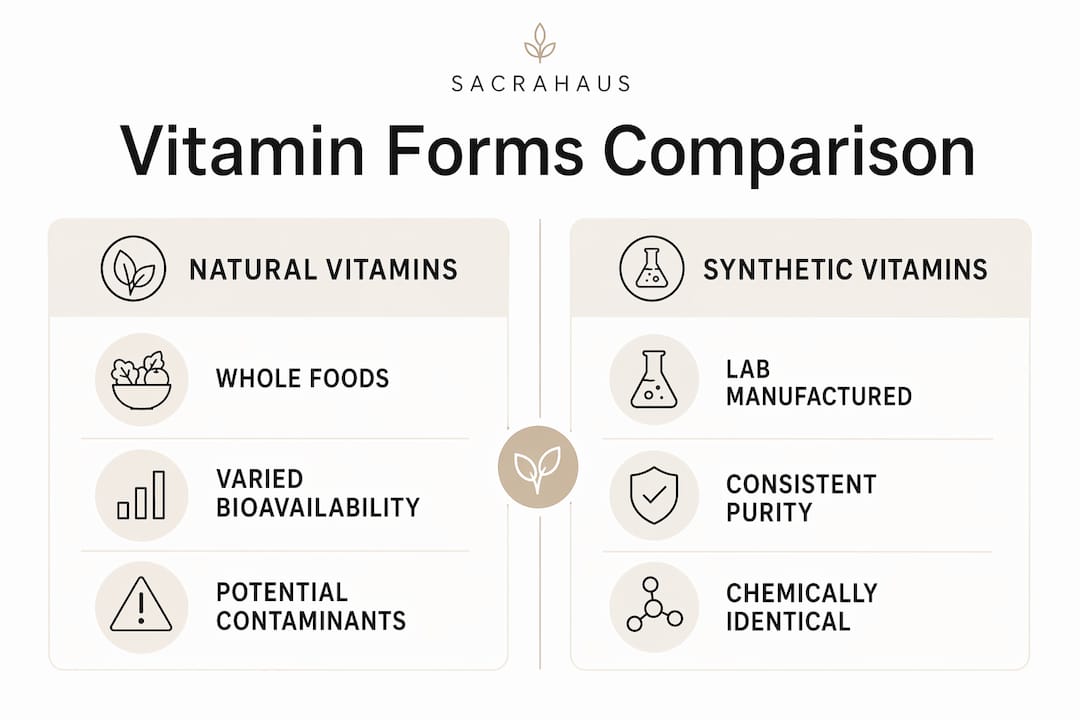
The scientific consensus is clear: synthetic vitamins can be chemically identical to their natural counterparts, and in those cases, the body cannot tell the difference. Vitamin C is the most cited example. Ascorbic acid synthesized in a lab shares the exact same molecular structure as ascorbic acid from an orange. Absorption rates and biological activity are the same.
Where synthetic production actually has an edge is purity. Natural-sourced vitamins carry contamination risks including pesticide residues and heavy metals absorbed from soil. Synthetic production happens in controlled environments that eliminate those variables and deliver consistent dosing. For people who need pharmaceutical-grade accuracy, a well-manufactured synthetic vitamin can be the cleaner option.
Biotechnology has blurred the line further. Fermented CoQ10, for example, is produced by microorganisms in a lab setting but is considered nature-identical because the molecular output matches what the body produces. The process is synthetic; the molecule is biologically equivalent. This category of "fermentation-derived" compounds sits between the two camps and often delivers the best of both.
Here is a practical framework for evaluating any vitamin supplement:
- Identify the chemical form on the label, not just the vitamin name.
- Check whether that form matches the research-backed version for your specific health goal.
- Verify the product carries third-party testing certification for purity and dose accuracy.
- Calculate your total daily intake across all supplements and fortified foods.
- Confirm the choice with a healthcare provider, especially if you take medications or have a diagnosed condition.
How to choose the right vitamin supplements for your needs
Reading a supplement label well is a skill most people never develop. The marketing front of a bottle says "natural," "whole food," or "plant-based." The ingredient list tells the truth. Your job is to match the chemical form on the ingredient list to the form supported by research for your specific need.
Third-party testing is non-negotiable for anyone serious about supplement quality. Certifications from organizations like NSF International or USP confirm that what is on the label is actually in the capsule, at the stated dose, without unlisted contaminants. This matters equally for natural and synthetic products. A clean ingredient supplement is defined by its testing record, not its marketing language.
Certain groups have specific form requirements. People with MTHFR variants need methylfolate, not folic acid. Vegans often need vitamin B12 as methylcobalamin or adenosylcobalamin rather than cyanocobalamin, which requires an extra conversion step. Pregnant people need preformed folate guidance from a provider, since both under-supplementation and over-supplementation carry risks.
| Health need | Preferred vitamin form | Why it matters |
|---|---|---|
| MTHFR gene variant | Methylfolate (5-MTHF) | Bypasses impaired conversion pathway |
| Bone and heart support | Vitamin K2 as MK-7 | Longer active half-life in bloodstream |
| Antioxidant support | d-alpha-tocopherol (Vitamin E) | ~2x more bioavailable than dl-alpha form |
| General immune support | Ascorbic acid (Vitamin C) | Identical regardless of natural or synthetic source |
| Vegan B12 support | Methylcobalamin | More readily used without conversion |
The COSMOS clinical trial, which followed over 21,000 participants, found that daily multivitamins showed modest cognitive benefits in older adults over 2–3 years but did not protect against heart disease or cancer. That finding reinforces a food-first philosophy: supplements fill gaps, they do not replace a nutrient-dense diet. Use them precisely, not broadly.
For people following a vegan or plant-based lifestyle, plant-based beauty supplements and dietary supplements formulated with bioavailable forms are worth prioritizing. The vegan market has matured enough that you no longer have to choose between ethical sourcing and clinical effectiveness.
Key Takeaways
Chemical form determines vitamin efficacy. Choosing the right form for your biology matters more than whether a vitamin is labeled natural or synthetic.
| Point | Details |
|---|---|
| Form beats origin | The chemical form of a vitamin determines absorption, not whether it came from food or a lab. |
| Vitamin E gap is real | Natural d-alpha-tocopherol is about twice as bioavailable as synthetic dl-alpha-tocopherol. |
| MTHFR changes folate needs | People with MTHFR variants absorb methylfolate far better than standard folic acid. |
| Fat-soluble vitamins accumulate | Vitamins A, D, E, and K build up in tissue and can reach toxic levels when stacked carelessly. |
| Third-party testing is the standard | Certifications from NSF International or USP confirm dose accuracy and purity for any supplement. |
The marketing myth I see costing people real money
The natural vs synthetic debate is, in large part, a marketing construct. I have watched people spend two to three times more on a "whole food vitamin C" supplement that delivers the same ascorbic acid molecule as a far cheaper option. The premium goes to the story on the front of the bottle, not to better outcomes.
That said, I do not dismiss the natural side entirely. The cases where form and source genuinely matter, like vitamin E stereoisomers or methylfolate for MTHFR variants, are real and clinically significant. The mistake is applying that nuance universally instead of selectively.
What I have found actually works is a simple rule: read the ingredient list before the marketing copy. If the chemical form matches the research-backed version for your need, the product earns consideration. If it does not, no amount of "ancient wisdom" or "whole food matrix" language changes that.
The other thing I push back on is the idea that supplements are a substitute for dietary variety. They are not. They are precision tools for filling specific gaps. Used that way, whether natural or synthetic, they work. Used as a nutritional safety net for a poor diet, neither form delivers.
Transparency in sourcing and third-party testing are the two standards I hold every supplement to, including the ones at Sacrahaus. If a brand cannot tell you exactly what form of a nutrient is in the capsule and who verified the dose, that is your answer.
— Sacrahaus
Clean, tested vegan supplements at Sacrahaus
Sacrahaus builds every supplement around the principle that form and purity matter more than marketing labels.

Every product in the vegan supplements collection is third-party tested, non-GMO, and made in the USA. Formulations use bioavailable vitamin and mineral forms backed by current research, so you are not paying for a form your body cannot use. For those following a plant-based lifestyle, the vegan essentials range covers iron, magnesium, and key minerals in forms chosen for absorption, not just label appeal. When the science points to a specific form, that is what goes into the product.
FAQ
What is the main difference between natural and synthetic vitamins?
Natural vitamins are derived from whole foods or plant extracts, while synthetic vitamins are produced in a lab. The key distinction is chemical form and bioavailability, not origin.
Are synthetic vitamins effective?
Yes. Synthetic ascorbic acid is chemically identical to vitamin C from food and absorbs the same way. Effectiveness depends on the specific vitamin and its chemical form.
Which vitamin form is better for MTHFR gene variants?
Methylfolate (5-MTHF) is the preferred form for people with MTHFR variants. Standard folic acid requires a conversion step that these individuals cannot perform efficiently.
Can taking too many natural supplements cause harm?
Yes. 20% of drug-induced liver damage cases are linked to misuse of dietary supplements, including natural ones. Fat-soluble vitamins accumulate in tissue and can reach toxic levels when multiple products are stacked.
How do I know if a supplement is high quality?
Look for third-party testing certifications from organizations like NSF International or USP. These confirm the dose on the label matches what is in the product and that no unlisted contaminants are present.