TL;DR:
- Third-party verification from accredited labs confirms mushroom supplement content and efficacy.
- Labels lacking independent testing and specific beta-glucan data may hide low active compound levels.
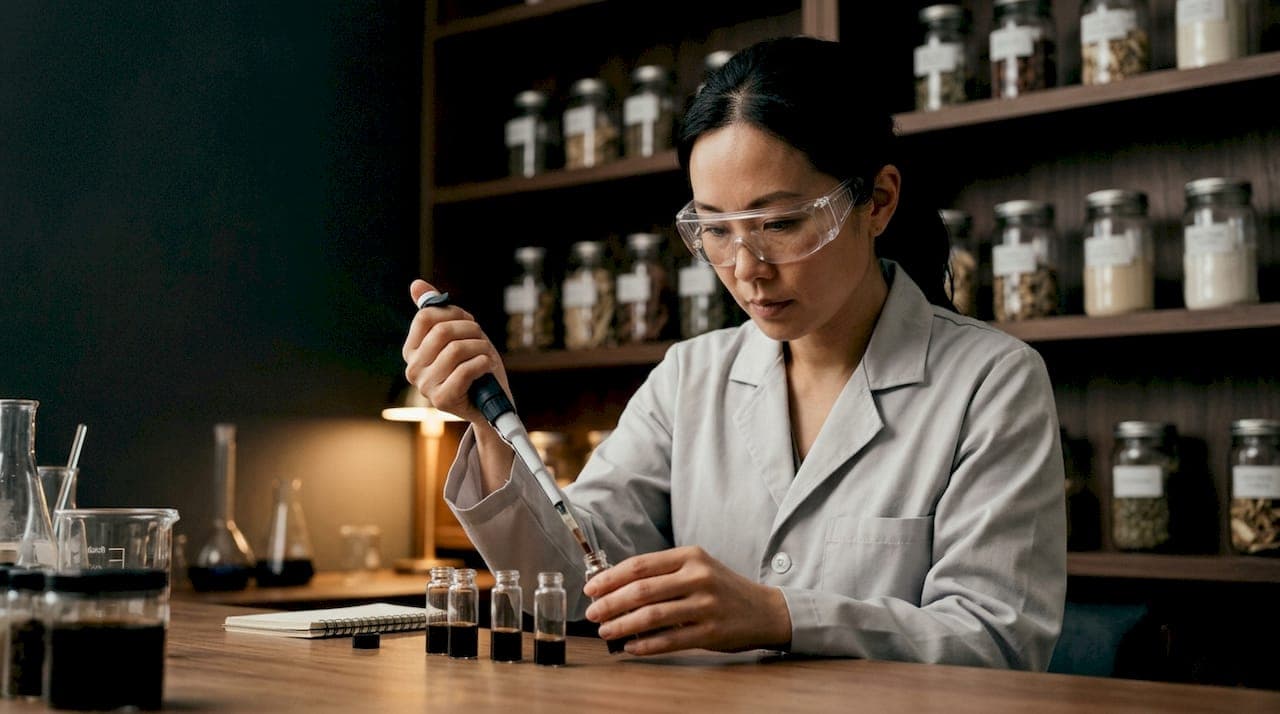
Mushroom extract verification is the process of independent, scientific testing that confirms the purity and potency of a mushroom supplement before it reaches you. Understanding why mushroom extract verification is important starts with one fact: supplement regulations as of 2026 do not require brands to disclose beta-glucan levels, the primary bioactivity marker in functional mushrooms. That gap places the burden of proof squarely on you. Without third-party verification from an ISO/IEC 17025-accredited lab, there is no reliable way to confirm that a product contains what its label claims, at the concentration needed to deliver real health benefits.
Why mushroom extract verification is important for your health
Verification matters because therapeutic benefits depend entirely on specific bioactive compounds. Without confirmed concentrations, a supplement risks being ineffective despite every claim on its label. The three most critical compound classes are beta-glucans, triterpenoids, and species-specific markers like cordycepin in Cordyceps militaris. Each one drives a different biological effect, from immune modulation to energy metabolism, and each one requires a different validated assay to measure accurately.
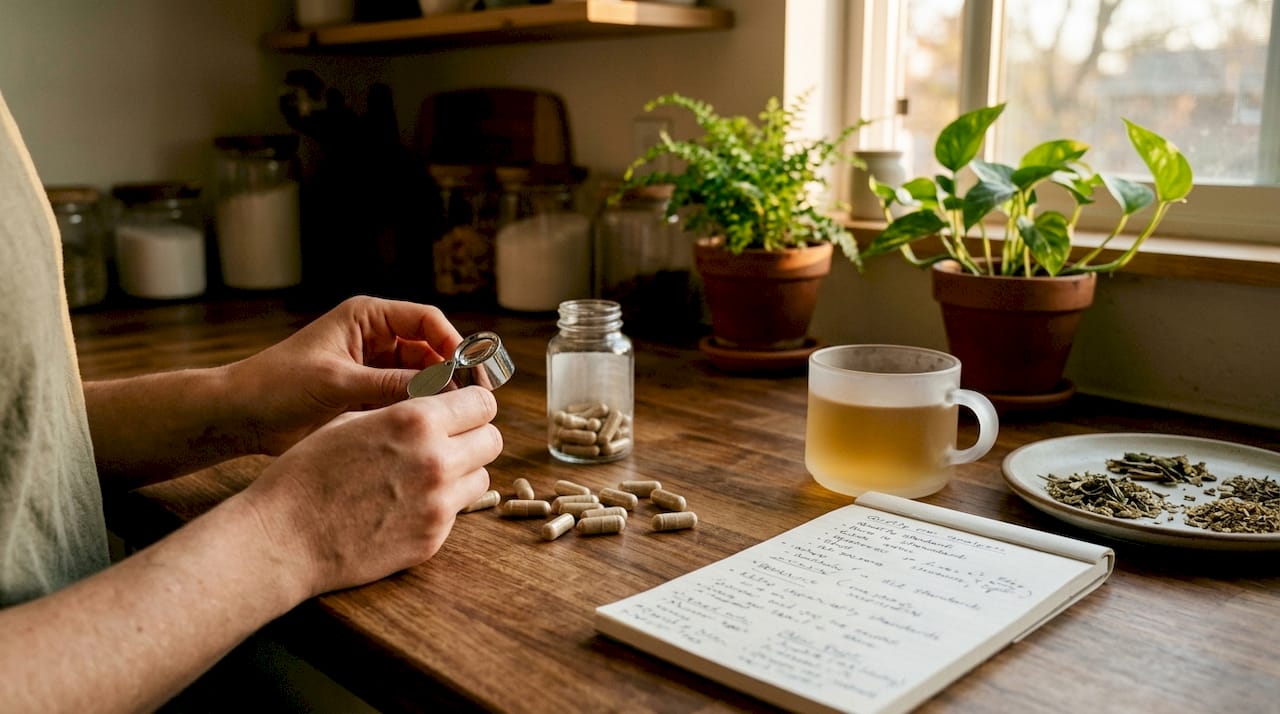
Beta-glucans are the most widely studied marker. Quality fruiting-body extracts contain 25–40% beta-glucans, while mycelium-on-grain products typically fall in the 1–5% range. That gap is not a minor formulation difference. It is the difference between a supplement that works and one that does not.
The standard for accurate beta-glucan measurement is the Megazyme enzymatic assay (K-YBGL), which quantifies (1→3),(1→6)-β-D-glucans while eliminating alpha-glucan interference from starch and grain fillers. The AOAC 995.16 method serves a similar function for dietary fiber contexts. Both methods are validated and reproducible. Labs that use them, and hold ISO/IEC 17025 accreditation, produce results you can actually trust.
Key quality markers to look for in any verified mushroom supplement:
- Beta-glucan percentage measured by the Megazyme or AOAC 995.16 enzymatic assay
- Species identity confirmed by DNA barcoding or HPLC fingerprinting
- Species-specific compounds such as cordycepin (Cordyceps), hericenones (Lion's Mane), or triterpenes (Reishi)
- Extraction method noted (hot water, dual extraction, or ethanol)
- Lab accreditation to ISO/IEC 17025 with no commercial relationship to the brand
Pro Tip: Total polysaccharide figures on a label are not a substitute for beta-glucan data. Starch from grain fillers inflates total polysaccharide counts, making a weak product look potent on paper.
What risks come from buying unverified mushroom supplements?
The risk is not theoretical. Independent testing shows many mushroom supplements on the market contain negligible active compounds, making them functionally inert. High-quality Cordyceps militaris extracts carry cordycepin levels above 0.3%. Lower-quality products show nearly undetectable levels of the same compound. You would be paying for a capsule of filler.
The most common source of this problem is mycelium-on-grain production. Manufacturers grow mycelium on a grain substrate like rice or oats, then grind the entire mixture into powder without separating the grain. The grain starch inflates total polysaccharide figures, making the product appear potent. The actual beta-glucan content from the mushroom itself is minimal.
| Issue | What it looks like | Why it matters |
|---|---|---|
| Mycelium-on-grain filler | High total polysaccharides, low beta-glucans | Grain starch inflates numbers without adding bioactivity |
| Unverified extraction ratios | "10:1 extract" on the label | Extraction ratios are not standardized or scientifically validated |
| Proprietary blends | No per-ingredient amounts listed | Hides underdosing of active compounds |
| Supplier-issued COAs | "Third-party tested" in marketing copy | Supplier tests are not independent finished-product verification |
Proprietary blends compound the problem. When a label lists a "mushroom complex" without per-ingredient amounts, there is no way to know whether any single species is present at a meaningful dose. A product can legally contain trace amounts of ten mushrooms and still call itself a complex.
Pro Tip: If a brand cannot provide a batch-specific Certificate of Analysis (COA) from an independent lab on request, treat the product as unverified, regardless of what the label says.
How do you read a Certificate of Analysis for mushroom extracts?
A Certificate of Analysis is a lab-issued document that reports the tested composition of a specific product batch. Genuine COAs include the lab name, batch number, test date, and specific compound concentrations measured by validated assays. A COA without all four of those elements is incomplete.
Reading a COA correctly takes about two minutes once you know what to check:
- Confirm the lab's accreditation. The COA should state ISO/IEC 17025 accreditation. You can verify this independently through the lab's national accreditation body database.
- Check the beta-glucan method. The assay name should appear next to the result. "Megazyme," "K-YBGL," or "AOAC 995.16" are acceptable. "Total polysaccharides" alone is not.
- Match the batch number. The batch number on the COA must match the batch number on the product you are buying. A COA from a different batch tells you nothing about the product in your hand.
- Look at the beta-glucan percentage. For fruiting-body extracts, expect 25–40%. Numbers below 10% in a product marketed as a premium extract are a red flag.
- Check for species identity. The COA should confirm the mushroom species tested, not just a generic "mushroom extract" label.
Red flags that signal a COA is unreliable: round numbers without decimal places (e.g., "30%" instead of "28.4%"), results reported only as total polysaccharides, a lab name that matches or is affiliated with the supplier, and no batch number or test date listed.
True independent testing requires an ISO/IEC 17025-accredited lab with no commercial relationship to the brand or its supplier. That independence is what makes the result credible.
Pro Tip: Search the lab name in your country's national accreditation body database (e.g., A2LA or NVLAP in the United States) to confirm ISO/IEC 17025 status before trusting any COA.
Steps to verify mushroom supplement quality before you buy
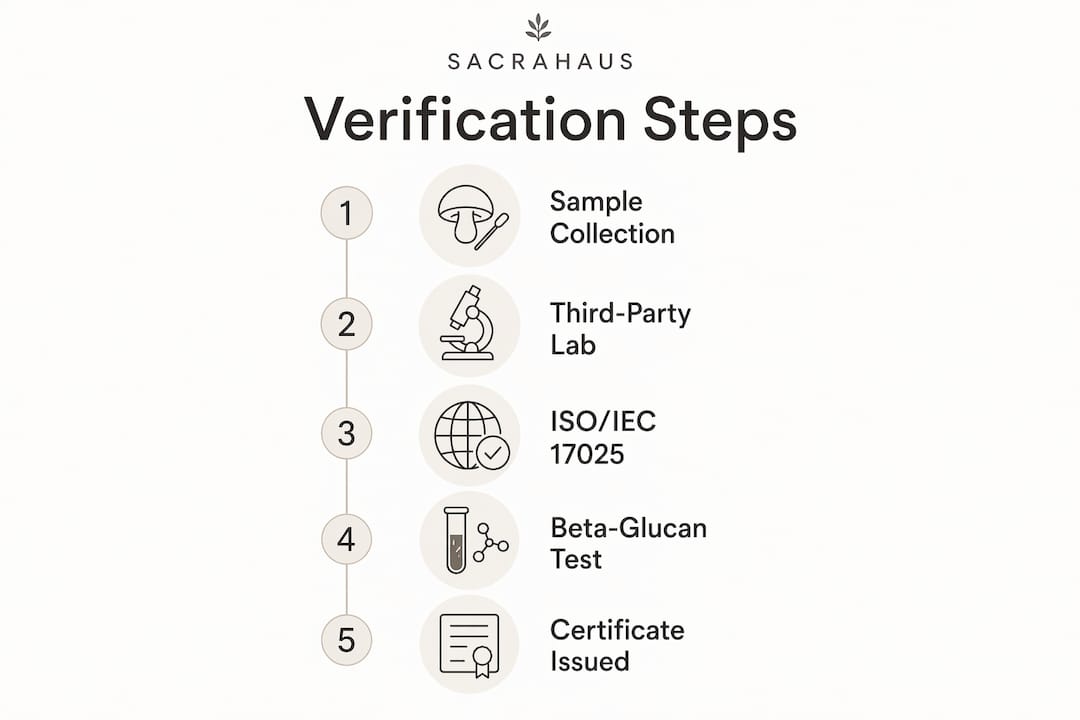
Verifying a mushroom supplement before purchase is a straightforward process. These steps apply whether you are buying a capsule, powder, or gummy format.
- Request a lot-specific COA. Ask the brand directly for the COA tied to the current batch. Reputable brands publish these on their website or provide them immediately on request.
- Confirm ISO/IEC 17025 lab accreditation. Cross-check the lab name against an accreditation database. This takes under five minutes and removes all doubt about independence.
- Check the label for fruiting body vs. mycelium. Fruiting-body extracts consistently deliver higher beta-glucan content. If the label says "mycelium" or does not specify, ask the brand to clarify.
- Ignore extraction ratios as quality signals. A "10:1" or "20:1" claim carries no scientific validation. Focus on the actual beta-glucan percentage from a validated assay instead.
- Use beta-glucan benchmarks. For Lion's Mane, look for at least 25% beta-glucans from fruiting body. For Reishi, expect triterpene content alongside beta-glucans. For Cordyceps militaris, cordycepin above 0.3% confirms potency.
- Check for clean label transparency. Brands that list every ingredient, its source, and its tested concentration are operating at a higher standard than those that do not.
The goal of these steps is not to distrust every brand. The goal is to reward the brands that invest in real verification by choosing them over those that do not.
Key Takeaways
Third-party verification from an ISO/IEC 17025-accredited lab is the only reliable way to confirm that a mushroom supplement contains active compounds at concentrations that deliver real health benefits.
| Point | Details |
|---|---|
| Verification fills a regulatory gap | Supplement labels are not required to disclose beta-glucan levels, so third-party testing is the only assurance. |
| Beta-glucans are the primary marker | Quality fruiting-body extracts contain 25–40% beta-glucans; mycelium-on-grain products contain 1–5%. |
| Megazyme assay is the gold standard | The K-YBGL enzymatic assay accurately measures fungal beta-glucans while excluding starch interference. |
| COAs must be batch-specific and independent | A genuine COA includes lab name, batch number, test date, and results from a validated assay. |
| Extraction ratios are not quality proof | "10:1" claims are not scientifically validated; only tested active compound percentages confirm potency. |
The transparency problem no one in the industry wants to admit
The phrase "third-party tested" has become one of the most misused claims in the supplement industry. Brands apply it to preliminary supplier tests, raw material certificates, and in-house lab results, none of which qualify as independent finished-product verification. The misuse of this claim is not accidental. It is a calculated use of language that sounds credible without committing to anything verifiable.
What I find most telling is how rarely brands publish batch-specific COAs proactively. If a product is genuinely verified, there is no reason to hide the data. The brands that post COAs publicly, with batch numbers you can match to the product in your cart, are the ones operating with real accountability. The ones that say "available upon request" and then go quiet are telling you something important.
The advances in chromatographic purification and HPLC-based testing have made accurate verification more accessible than ever. The barrier is not technology. The barrier is the willingness to pay for independent testing and publish the results. Consumers who identify clean ingredient supplements and demand verified data are the ones driving the brands that actually invest in this standard to grow.
My honest view: the regulatory gap will not close quickly. The burden stays on you for now. But that burden is manageable when you know exactly what to ask for and what a legitimate answer looks like.
— Sacrahaus
Sacrahaus mushroom supplements: verified quality, published results
Sacrahaus tests every batch of its mushroom supplements through ISO/IEC 17025-accredited independent labs. COAs are available for each product, showing beta-glucan percentages measured by validated enzymatic assays, species identity, and batch-specific data you can match to your order.
Every Sacrahaus mushroom formula uses fruiting-body extracts, not mycelium-on-grain fillers, and all products are non-GMO and made in the USA. The Mushroom Complex Supplement and Cordyceps Vegan Gummies are among the most popular verified options. Browse the full range of verified vegan supplements and check the COA for any product before you add it to your cart.
FAQ
What is mushroom extract verification?
Mushroom extract verification is independent, third-party laboratory testing that confirms the identity, purity, and active compound concentrations of a mushroom supplement. It requires ISO/IEC 17025-accredited labs with no commercial relationship to the brand.
Why are beta-glucans the key quality marker?
Beta-glucans are the primary bioactive compounds responsible for the immune and health benefits of functional mushrooms. Quality fruiting-body extracts contain 25–40% beta-glucans, while low-quality mycelium-on-grain products contain only 1–5%.
Are extraction ratios like "10:1" reliable quality indicators?
No. Extraction ratios are not scientifically standardized or validated, so they cannot confirm potency. Only tested active compound percentages from a validated assay like the Megazyme K-YBGL method confirm real quality.
What makes a COA trustworthy?
A trustworthy COA comes from an ISO/IEC 17025-accredited lab, lists the batch number and test date, reports specific compound concentrations by named validated methods, and has no commercial connection to the brand or its supplier.
How do I know if a mushroom supplement uses fruiting body or mycelium?
Check the label for the words "fruiting body" or "mycelium." If the label is unclear, ask the brand directly and request a COA that confirms the mushroom part used and the corresponding beta-glucan percentage.