
TL;DR:
- Vegans cannot obtain reliable B12 from unfortified plant foods, making supplementation essential.
- Inadequate B12 intake can lead to serious, irreversible health issues, including nerve damage and anemia.
Vitamin B12 is defined as a water-soluble nutrient that the human body cannot produce on its own, making it one of the most critical nutrients for vegans to obtain externally. It drives DNA synthesis, maintains the myelin sheath around nerve fibers, and produces healthy red blood cells. Plant-based diets provide no reliable natural source of bioavailable B12, which is why understanding why vitamin B12 is vegan essential goes beyond basic nutrition. Research shows 44.1% of vegans are deficient, compared to 15% of lacto-ovo vegetarians. That gap is not a coincidence. It is a direct consequence of diet structure.
Why is vitamin B12 essential for vegans?
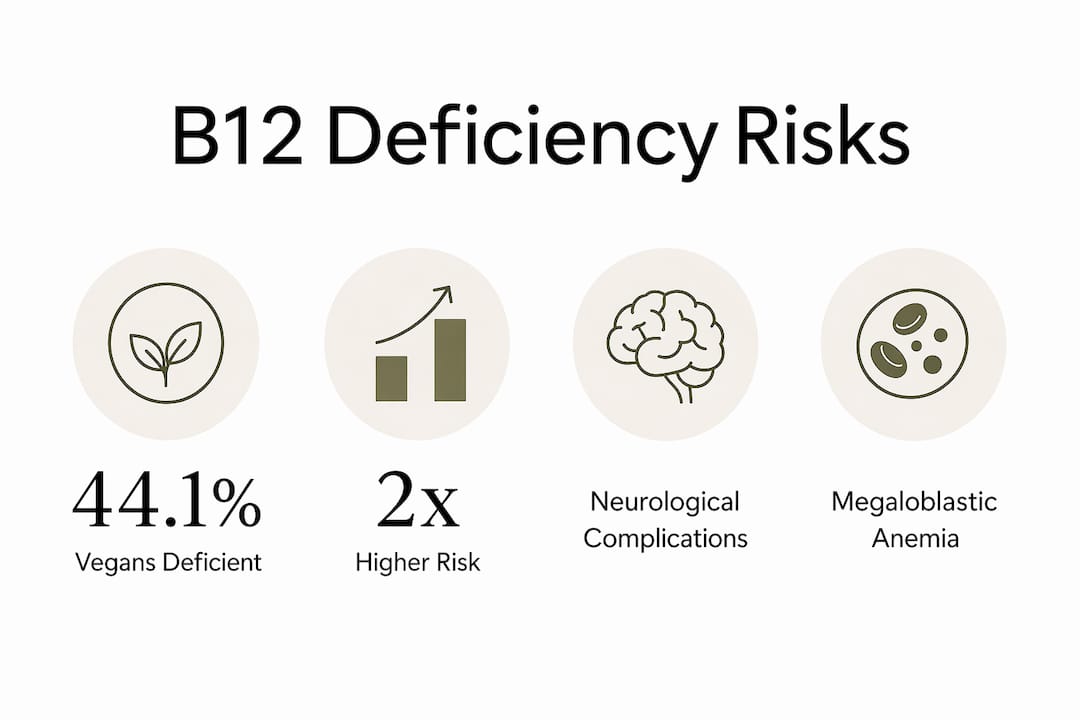
Vitamin B12 performs three functions that no other nutrient can replace. It synthesizes DNA in every dividing cell, maintains the myelin sheath that insulates nerve fibers, and drives the production of red blood cells in bone marrow. When any of these processes fails, the consequences are serious and often irreversible.
The absorption pathway for B12 is more complex than most vitamins. The stomach produces a protein called intrinsic factor, which binds to B12 and carries it to the small intestine for absorption. Without intrinsic factor, dietary B12 passes through the gut unused. This means even people who consume some B12 can still become deficient if their gut function is compromised.
The liver stores roughly 2–5 mg of B12, enough to last 3–5 years. That sounds reassuring until you realize it means deficiency builds silently for years before any symptom appears. By the time numbness, fatigue, or cognitive decline shows up, neurological damage may already be underway.
- DNA synthesis: B12 works with folate to build and repair DNA. A shortage causes cells to divide abnormally, leading to megaloblastic anemia.
- Nerve protection: Myelin degradation from B12 deficiency causes tingling, weakness, and, in severe cases, paralysis.
- Red blood cell production: Without B12, red blood cells grow oversized and dysfunctional, reducing oxygen delivery throughout the body.
- Cognitive function: Low B12 is linked to elevated homocysteine, a compound associated with dementia and stroke risk.
Pro Tip: If you are new to a vegan diet, get a baseline B12 blood test before symptoms appear. Your liver stores may mask deficiency for years, giving you a false sense of security.
Why do vegan diets lack adequate vitamin B12?
B12 is synthesized exclusively by bacteria, not by plants or animals. Animals accumulate B12 by consuming bacteria in soil, water, or fermented matter. Humans historically got trace amounts the same way, through unwashed produce and untreated water. Modern food hygiene, while necessary, has eliminated that incidental exposure.
No unfortified plant food contains bioavailable B12 in meaningful amounts. This is the single most important fact for vegans to internalize. Some algae, including spirulina and nori, contain B12-like compounds called corrinoids. These analogs bind to B12 receptors in the body without delivering B12's actual function. Worse, they can block absorption of true B12, making the situation worse rather than better.
Fermented foods like tempeh, miso, and kimchi are often cited as vegan B12 sources. They are not. Fermentation does not reliably produce bioavailable B12, and the amounts detected in lab tests vary wildly between batches. Relying on these foods for B12 is a nutritional gamble with serious stakes.
Fortified foods and supplements are the only two reliable options for vegans. Fortified plant milks, breakfast cereals, and nutritional yeast can contribute meaningfully, but only if consumed consistently and in sufficient quantity. Most nutrition researchers and registered dietitians treat supplementation as non-negotiable for vegans who want to maintain adequate levels long-term.
What are the health risks of B12 deficiency for vegans?
The prevalence of B12 deficiency among vegans reaches 44.1%, more than double the rate seen in lacto-ovo vegetarians. That statistic reflects a structural gap in plant-based diets, not individual carelessness. Many of those people feel fine, at least initially.
B12 deficiency progresses silently for years before symptoms become obvious. The liver's stored reserves mask the problem while cellular damage accumulates. By the time a person notices persistent fatigue, tingling in the hands and feet, or difficulty concentrating, the deficiency has often been active for a long time.
| Complication | Description |
|---|---|
| Megaloblastic anemia | Oversized, dysfunctional red blood cells reduce oxygen delivery to tissues |
| Peripheral neuropathy | Myelin damage causes numbness, tingling, and weakness in limbs |
| Cognitive decline | Elevated homocysteine from low B12 accelerates memory loss and confusion |
| Dementia and stroke | Untreated deficiency raises the risk of permanent neurological deficits |
| Subacute combined degeneration | Spinal cord damage from prolonged deficiency, often irreversible |
Standard serum B12 blood tests frequently miss true cellular deficiency. A person can show a "normal" serum B12 reading while their cells are starved of the nutrient. Accurate diagnosis requires metabolic markers like methylmalonic acid (MMA) and homocysteine, which rise when B12 is functionally insufficient at the cellular level. Ask your doctor for both tests, not just serum B12.
Adults over 50 face compounded risk. Reduced stomach acid production with age impairs the liberation of B12 from food, making fortified sources and supplements even more critical for older vegans.
How can vegans get enough vitamin B12?
Supplementation is the most reliable method. Experts recommend either 250 mcg of cyanocobalamin daily or a high-dose weekly supplement of 2,000–2,500 mcg. The weekly high-dose approach works because a small percentage of B12 absorbs passively through the gut lining without requiring intrinsic factor. Higher doses compensate for that low passive absorption rate.
Cyanocobalamin vs. methylcobalamin
Cyanocobalamin is the most stable and well-studied supplemental form of B12. Methylcobalamin degrades in the presence of vitamin C, thiamin, and niacin, which are common in multivitamins. This makes methylcobalamin a poor choice in combination supplements unless the formula is specifically stabilized. Cyanocobalamin converts to active B12 in the body and maintains potency on the shelf.
Methylcobalamin is marketed heavily as the "natural" or "superior" form. The evidence does not support that claim for most people. Unless a clinician has identified a specific metabolic reason to use methylcobalamin, cyanocobalamin is the better-studied and more reliable option.
Fortified foods as a daily strategy
Fortified plant milks, nutritional yeast, and breakfast cereals can contribute to daily B12 intake. The key word is "contribute." Fortified foods work best as a complement to supplementation, not a replacement. Serving sizes matter, and B12 content varies significantly between brands. Check the label for micrograms per serving, not just the presence of B12 on the ingredient list.
Pro Tip: When choosing a clean vegan supplement, look for cyanocobalamin as the listed B12 form and verify third-party testing. A supplement that has not been independently tested for potency and purity is a guess, not a guarantee.
What are the biggest myths about B12 and vegan diets?
Several widely repeated claims about B12 mislead vegans into false confidence. Knowing which ones are wrong protects your health.
- "Spirulina provides B12." Spirulina contains B12 analogs that block true B12 absorption. It is not a substitute and may actively worsen deficiency.
- "Fermented foods cover B12 needs." Fermentation does not reliably produce bioavailable B12. Batch variation is too high to depend on.
- "I feel fine, so I'm not deficient." The liver stores 3–5 years of B12. Feeling fine does not mean your levels are adequate. Damage accumulates before symptoms appear.
- "B12 supplements give you energy." B12 supplements restore normal function in deficient people. They do not boost energy beyond correcting a deficiency. If your levels are already adequate, taking more B12 will not increase your energy.
- "A multivitamin covers it." Many multivitamins use methylcobalamin, which degrades in combination formulas. The dose is also often too low for vegans who rely on it as their sole B12 source.
- "Social media wellness accounts are reliable guides." B12 supplementation protocols are based on clinical research, not trends. A registered dietitian or physician familiar with plant-based nutrition is the right source for personalized guidance.
The pattern across all these myths is the same. They offer comfort without evidence. Vegans who rely on them delay testing and supplementation until symptoms force the issue.
Key Takeaways
Vegans cannot obtain reliable B12 from unfortified plant foods, making consistent supplementation with cyanocobalamin the single most important nutritional action for long-term plant-based health.
| Point | Details |
|---|---|
| B12 deficiency is common in vegans | Research shows 44.1% of vegans are deficient, far exceeding rates in other dietary groups. |
| Plant foods provide no reliable B12 | No unfortified plant food contains bioavailable B12; bacteria produce it, not plants. |
| Deficiency progresses silently | Liver stores mask deficiency for 3–5 years, allowing neurological damage before symptoms appear. |
| Cyanocobalamin is the preferred supplement form | It is more stable than methylcobalamin and better studied for long-term vegan supplementation. |
| Standard blood tests can miss deficiency | Request MMA and homocysteine markers alongside serum B12 for an accurate picture. |
The uncomfortable truth about B12 that vegan wellness culture avoids
The vegan wellness space has a complicated relationship with B12. Supplements are sometimes framed as a sign that plant-based diets are incomplete, so the conversation gets minimized or redirected toward food-first solutions that simply do not work for this particular nutrient.
After years of working with plant-based nutrition, the pattern is clear. The vegans who thrive long-term are not the ones who found a clever food workaround. They are the ones who accepted early that B12 supplementation is not a compromise. It is a biological reality. Bacteria make B12. Humans need it. The supply chain that once connected those two facts through soil and water no longer exists in modern food systems.
The science on this is not evolving in a direction that will rescue spirulina or fermented foods as reliable sources. If anything, research keeps reinforcing that cyanocobalamin supplementation at the recommended doses is the only approach with consistent evidence behind it. Choosing supplements based on marketing language like "natural" or "bioidentical" over stability data is how people end up with degraded methylcobalamin in a multivitamin and a false sense of coverage.
The most responsible thing a vegan can do for their long-term health is treat B12 supplementation the way they treat brushing their teeth. Non-negotiable, consistent, and not something to optimize away.
— Sacrahaus
Sacrahaus vegan supplements for complete nutritional support
Covering your B12 needs is one piece of a larger picture. Vegans often need to address iron, magnesium, and other nutrients that plant-based diets can fall short on.
Sacrahaus formulates its vegan essentials collection with third-party tested, non-GMO ingredients made in the USA. Every product is built for people who take their plant-based nutrition seriously and want supplements that match that standard. From vegan iron strips to a full range of plant-based vitamins and supplements, Sacrahaus covers the nutrients that matter most for long-term vegan health. Free worldwide shipping is included on every order.
FAQ
Do vegans really need to supplement B12?
Yes. No unfortified plant food provides bioavailable B12, and research shows 44.1% of vegans are deficient. Supplementation with cyanocobalamin is the only consistently reliable solution.
What is the correct B12 dose for vegans?
Experts recommend 250 mcg of cyanocobalamin daily or 2,000–2,500 mcg once weekly. The weekly high-dose approach compensates for the low passive absorption rate that bypasses intrinsic factor.
Can a standard blood test detect B12 deficiency?
Standard serum B12 tests frequently miss cellular deficiency. Accurate assessment requires metabolic markers like methylmalonic acid (MMA) and homocysteine alongside the serum B12 reading.
Is methylcobalamin better than cyanocobalamin for vegans?
Cyanocobalamin is more stable and better studied. Methylcobalamin degrades in the presence of vitamin C, thiamin, and niacin, making it unreliable in most multivitamin formulas.
How long can a vegan go without B12 before showing symptoms?
The liver stores 2–5 mg of B12, enough for 3–5 years. This delay means deficiency can cause significant neurological damage long before any symptom appears, which is why early testing matters.