
TL;DR:
- Supplement manufacturing involves a regulated, multi-stage process focused on quality, safety, and compliance. Proper testing, validated procedures, and thorough documentation ensure the finished product is safe, effective, and accurately labeled.
Supplement manufacturing is the controlled, multi-stage process of transforming raw botanical, mineral, and nutritional ingredients into finished dietary products that meet federal safety and labeling standards. FDA 21 CFR Part 111 governs this process under current Good Manufacturing Practices, or cGMPs, requiring controls over personnel, sanitation, equipment calibration, documentation, and quality testing at every stage. Understanding how supplement manufacturing works is not just useful for entrepreneurs launching a product. It is the foundation for making informed decisions about what you put in your body and whose products you trust.
How does the supplement manufacturing process work from start to finish?
The supplement manufacturing cycle moves through a defined sequence: formula development, ingredient sourcing with Certificates of Analysis (COAs), quarantine and identity testing, blending, product formation, in-process quality control, packaging, lot coding, and traceability documentation. Each stage feeds directly into the next. A failure at any point, whether a contaminated raw material or an improperly calibrated scale, can compromise the entire batch.
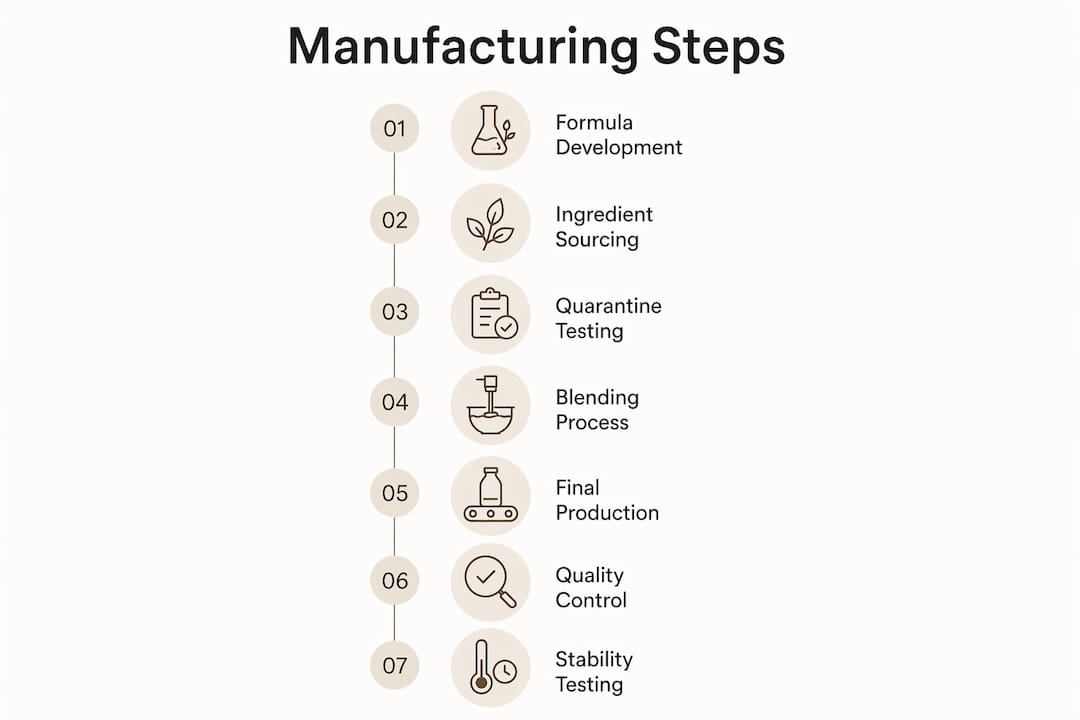
Most people picture supplement production as mixing powders in a large tank. The reality is closer to pharmaceutical manufacturing, with validated equipment, documented procedures, and regulatory inspections that can shut down a facility for missing paperwork.
| Stage | Key quality checkpoint |
|---|---|
| Formula development | Ingredient compatibility, bioavailability review |
| Ingredient sourcing | Certificate of Analysis from each supplier |
| Quarantine and identity testing | Verify purity, potency, and absence of contaminants |
| Blending | Validated parameters: time, speed, humidity, load |
| Product formation | Weight, fill volume, hardness, disintegration |
| Packaging and labeling | Lot code, expiration date, label accuracy |
Pro Tip: Before signing with any contract manufacturer, ask to see their Standard Operating Procedures (SOPs) for blending and in-process testing. A manufacturer who cannot produce these documents quickly is a red flag.
Formula development is where nutritional supplement production actually begins. A formulator evaluates which ingredients work together, how they interact chemically, and whether the chosen delivery form, such as a capsule, powder, or gummy, preserves potency through the product's shelf life. Pre-production decisions at this stage have more impact on product success than the manufacturing run itself. Getting the formula right before production starts saves significant time and cost downstream.
How is ingredient sourcing and testing carried out to guarantee quality?
Raw material integrity is the single biggest variable in supplement quality. Every ingredient that enters a cGMP facility must arrive with a COA from the supplier, which documents the material's identity, purity, and potency. That COA is not taken at face value. The facility's quality control team tests raw materials independently before releasing them into production, using identity testing methods such as FTIR spectroscopy or HPLC analysis to confirm what the label claims.
Quarantine is a mandatory step under FDA cGMP. Every incoming shipment sits in a designated quarantine area until testing confirms it meets the approved specification. This step limits contamination risk and creates a traceable record linking each raw material to the finished lot.
Microbial testing and heavy metal screening are not optional. cGMP regulations require manufacturers to verify that raw materials fall within acceptable limits for pathogens like Salmonella and E. coli, as well as for heavy metals including lead, arsenic, cadmium, and mercury. These tests protect consumers and protect brands from recalls.
To identify clean ingredient supplements, look for products whose brands publish third-party COA results or display a certificate of analysis on request. Transparency at this level signals that the manufacturer takes raw material testing seriously.
Pro Tip: Ingredient weighing errors are the leading cause of potency deviation in finished supplements. The industry standard uses dual-verification weighing: two separate operators confirm each ingredient weight on calibrated scales before blending begins. Ask your manufacturer if this practice is in their SOPs.
What production techniques and equipment are used in blending and product formation?
Blending is where formulation science meets mechanical precision. Ribbon blenders and V-blenders are the two most common equipment types in nutritional supplement production. A ribbon blender uses a horizontal trough with spiral blades to fold ingredients together, making it well suited for dense powders. A V-blender tumbles ingredients in a V-shaped vessel and works better for free-flowing materials that need gentle mixing.
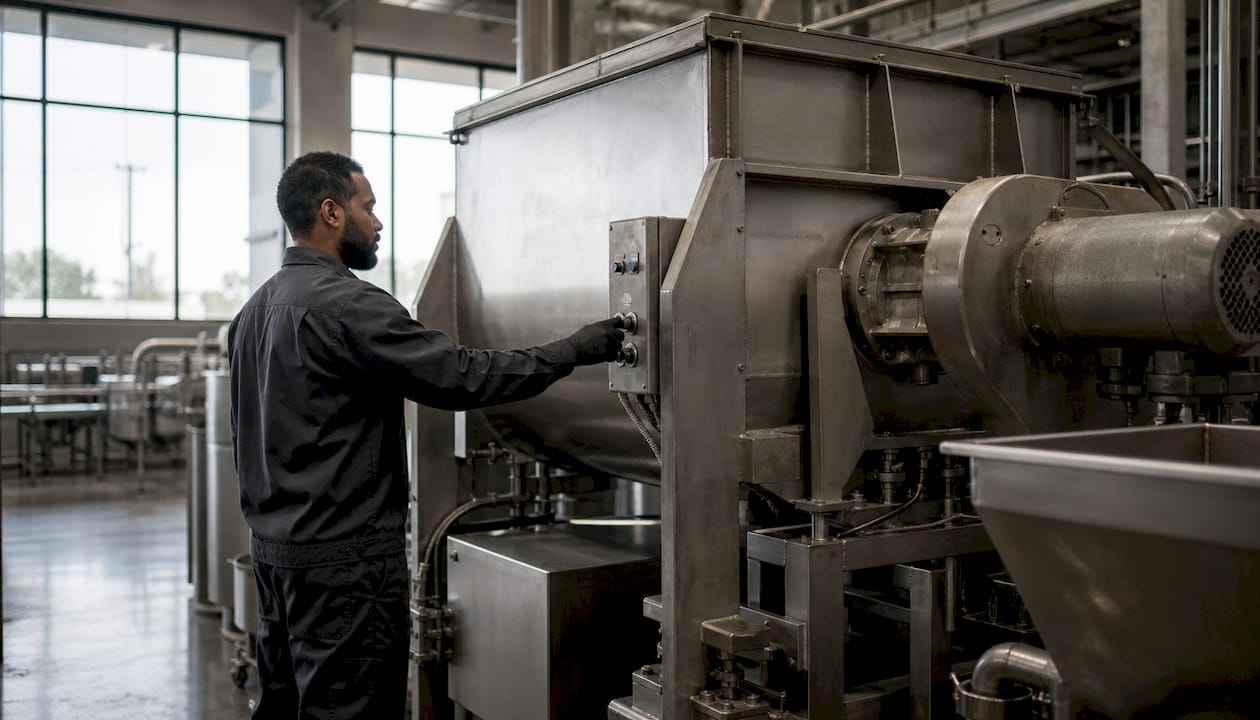
Blending parameters including time, speed, and load must be validated and strictly followed. Deviating from a validated blend time by even a few minutes can create hot spots where one ingredient concentrates unevenly, leading to potency variation across the batch. Humidity control matters just as much. Moisture-sensitive ingredients like magnesium glycinate or ashwagandha extract can clump or degrade if the blending room exceeds specified relative humidity levels.
Encapsulation, tablet compression, and gummy molding
Once blending is complete, the product moves into its final form. Encapsulation machines fill hard-shell capsules at high speed, typically thousands per minute, while sensors check fill weight continuously. Tablet compression presses blend into solid tablets under controlled force, with hardness and disintegration time tested at regular intervals during the run.
Gummy manufacturing follows a different path. The blend is combined with a gelling agent, poured into molds, and cooled under controlled temperature and humidity. Gummy production requires tighter environmental controls than capsule or tablet manufacturing because the gel matrix is sensitive to both heat and moisture during setting.
In-process quality control checks run throughout every production form:
- Fill weight or tablet weight checked every 15–30 minutes
- Hardness and friability tested on tablet runs
- Disintegration time verified to confirm the product will break down properly
- Visual inspection for color consistency, capping, or surface defects
Pro Tip: Powdered supplements require bulk density testing before filling to confirm the powder will fit the intended container at the labeled serving size. Skipping this step is a common cause of underfilled containers and label non-compliance.
How is quality control integrated throughout manufacturing and tested in finished products?
Quality control in supplement manufacturing is not a final checkpoint. In-process testing runs continuously during production, covering fill weights, hardness, disintegration, and environmental conditions like temperature and humidity in the production room. This continuous monitoring catches deviations early, before they affect an entire batch.
Finished product testing is the last gate before a product ships. Every lot must pass testing for:
- Potency: Active ingredient levels match the label claim within an acceptable variance
- Identity: The product contains what it claims and nothing else
- Microbial safety: Pathogen counts fall within FDA-specified limits
- Heavy metals: Lead, arsenic, cadmium, and mercury levels meet regulatory thresholds
Finished product results must match the master manufacturing record specifications before the quality unit releases the lot for sale. If any result falls outside specification, the batch is quarantined and investigated.
Stability testing and shelf life validation
Stability testing uses two methods: real-time studies that store product under normal conditions for the full claimed shelf life, and accelerated studies that use elevated temperature and humidity to predict degradation faster. Both methods inform the expiration date printed on the label. A product with a two-year shelf life claim needs data showing the active ingredients remain potent at that point, not just at the time of manufacture.
Batch records tie everything together. Each produced lot generates a batch record that documents every raw material used, every operator who touched the batch, every in-process test result, and every deviation from the standard procedure. Batch records are the legal backbone of cGMP compliance. During an FDA inspection, they are the first documents reviewed.
Key Takeaways
Supplement manufacturing is a regulated, multi-stage process where quality control, validated procedures, and complete documentation at every step determine whether a finished product is safe, effective, and legally compliant.
| Point | Details |
|---|---|
| Regulatory framework | FDA 21 CFR Part 111 cGMP governs every stage from raw materials to finished product. |
| Raw material testing | Every ingredient requires a COA and independent identity testing before entering production. |
| Blending validation | Parameters like time, speed, and humidity must be validated to prevent potency variation. |
| Continuous quality control | In-process testing runs throughout production, not only at the end of a batch. |
| Stability documentation | Shelf life claims require real-time or accelerated stability data backed by batch records. |
What most people get wrong about supplement quality
Most entrepreneurs entering the supplement space assume that finding a cGMP-certified manufacturer is the finish line. It is not. Certification tells you a facility follows documented procedures. It does not tell you whether those procedures are rigorous, whether the raw materials are genuinely tested, or whether the formulation was designed with bioavailability in mind.
Formulation science is a technical discipline that accounts for ingredient interactions and bioavailability throughout shelf life. Two products with identical label claims can perform very differently depending on the form of the ingredient used, the excipients chosen, and how the product was stabilized. A magnesium oxide supplement and a magnesium glycinate supplement carry the same mineral, but their absorption rates differ significantly. That difference lives in the formulation, not the manufacturing line.
The other thing most people overlook is stability validation. Brands routinely launch products with expiration dates based on industry convention rather than actual stability data. That means a consumer buying a product in month 18 of a 24-month shelf life may be getting a fraction of the labeled potency. At Sacrahaus, stability validation is treated as a non-negotiable step, not an afterthought. The plant-based beauty supplements in our catalog go through the same testing rigor as any other product in the line.
For entrepreneurs vetting manufacturers, the most useful question is not "Are you cGMP certified?" It is "Can I see your last three batch records and your stability data for a comparable product?" The answer to that question tells you everything about how seriously a manufacturer takes quality.
— Sacrahaus
Sacrahaus: where manufacturing standards meet clean formulas
Every Sacrahaus product is made in the USA under cGMP-compliant conditions, formulated with plant-based, non-GMO ingredients, and third-party tested before it reaches you. The same standards described in this article, from dual-verification weighing to finished product potency testing, apply to every item in the catalog.

If you are building a wellness routine or evaluating a supplement brand, the manufacturing process behind the product matters as much as the label. Browse the full vegan supplement collection to see products built on the quality controls covered here, or explore vegan essentials for curated formulas covering iron, magnesium, creatine, and greens. Every product ships free worldwide, with no minimum order.
FAQ
What is supplement manufacturing?
Supplement manufacturing is the regulated process of producing dietary products from raw ingredients under FDA 21 CFR Part 111 cGMP standards. It covers formula development, ingredient testing, blending, product formation, quality control, and packaging.
How are supplements made step by step?
The steps in supplement manufacturing run from formula development and ingredient sourcing through quarantine testing, blending, encapsulation or compression, in-process quality checks, finished product testing, and packaging with lot coding.
What does cGMP mean for supplement production?
cGMP stands for current Good Manufacturing Practices. It is the FDA regulatory framework requiring supplement manufacturers to maintain documented controls over personnel, equipment, raw materials, production, and quality testing.
Why does ingredient testing matter before manufacturing?
Raw materials must pass identity, purity, and contaminant testing before entering production because ingredient quality directly determines finished product potency and safety. Skipping this step is the most common source of label inaccuracy and contamination risk.
How long does stability testing take for supplements?
Real-time stability studies run for the full claimed shelf life, often 24 months or more. Accelerated studies compress that timeline using elevated temperature and humidity, but real-time data is still required to support the final expiration date on the label.