
TL;DR:
- Reading vegan supplement labels requires verifying third-party certification seals to ensure full supply chain transparency. Self-declared "vegan" claims need ingredient list review since they carry no legal guarantee. Checking serving sizes, elemental amounts, and ingredient sources helps confirm accurate dosing and plant-based ingredients.
Reading vegan supplement labels is the most direct way to confirm that a product actually matches its plant-based claims. The challenge is that "vegan" and "plant-based" are unregulated terms under FDA guidelines, meaning any manufacturer can print them on a bottle without verifying a single ingredient source. Third-party certifications from bodies like Vegan Action and The Vegan Society close that gap by auditing the full supply chain. Knowing how to decode the Supplement Facts panel, the ingredient list, and the certification seals on a label puts you in control of what you actually put in your body.
What do vegan claims and certifications on supplement labels really mean?
A self-declared "vegan" label carries no legal weight. Manufacturers can apply that term without confirming that every ingredient, capsule, coating, or processing aid is free from animal-derived inputs. That is the core problem with front-of-pack marketing claims, which routinely differ from what the back-of-pack ingredient list actually reveals.
Third-party certification changes that equation. Certifications from Vegan Action, The Vegan Society, and the American Vegetarian Association require documented supply chain verification, meaning auditors confirm that no animal-derived inputs entered the product at any stage. That is a fundamentally different standard than a brand simply deciding to call itself vegan.
Here is what each label type actually signals:
- Certified vegan seal (Vegan Action, The Vegan Society): Supply chain audited. Animal-derived inputs excluded at every production stage. The most reliable indicator on a label.
- "Vegan" text claim (self-declared): No external audit. The brand made a judgment call. Requires your own ingredient list review to verify.
- "Plant-based" text claim: No regulatory definition. Can appear on products that contain animal-derived processing aids or capsule materials.
- "Natural" or "clean label": "Clean label" is a marketing term with no regulatory definition, often implying no artificial colorants or fillers but varying widely by manufacturer.
- "Vegetarian" certification: Excludes meat but may permit dairy, eggs, lanolin, or beeswax. Not equivalent to vegan.
A product with fewer, well-identified ingredients combined with third-party certification is generally more trustworthy than one with many ingredients and unverified marketing claims. Transparency correlates directly with certification presence and inversely with ingredient count.
Understanding certified vegan label standards before you shop saves time and prevents costly mistakes at the checkout.
How to interpret serving sizes, elemental amounts, and ingredient lists
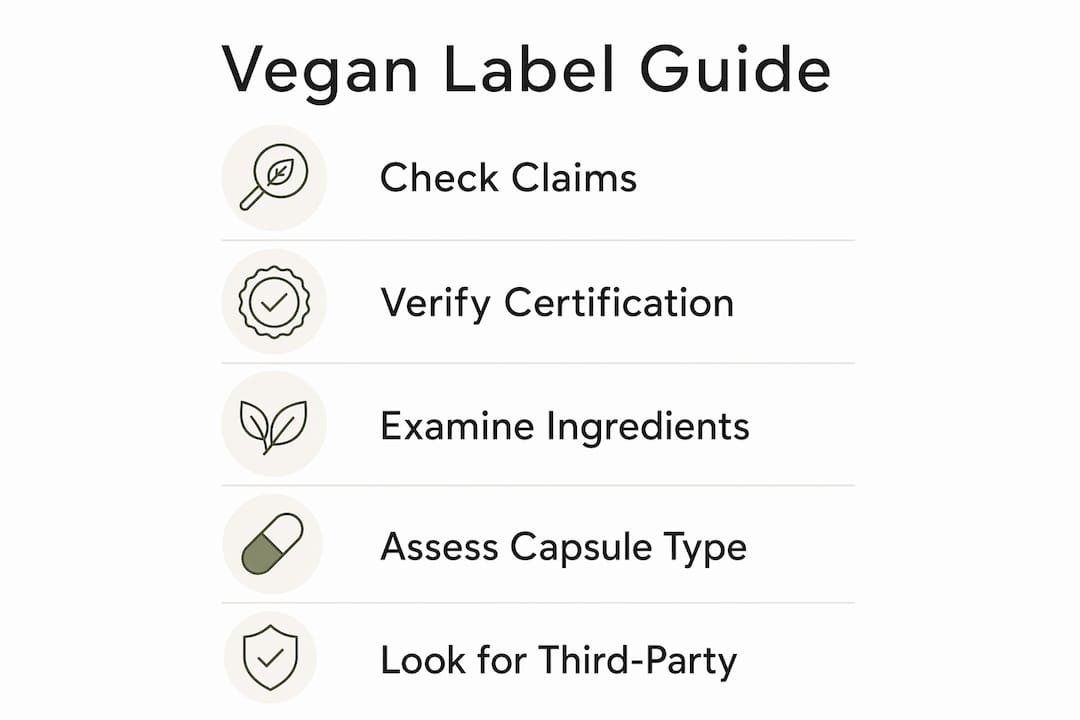
The Supplement Facts panel is the regulatory core of any label. Reading it correctly requires understanding three distinct layers: serving size, active amounts, and the full ingredient list.

Serving size and pill count
Serving size is often listed as two or three capsules, not one. A label showing "500 mg of magnesium per serving" may require three capsules to deliver that dose. If you take one capsule assuming it covers your daily need, you are underdosing significantly. Always multiply the per-serving amount by the number of capsules you actually take.
Elemental amounts versus compound weights
This is the most misread section on any mineral supplement. Serving size and active elemental amounts differ in ways that directly affect your dosing accuracy. Magnesium oxide, for example, weighs more than the elemental magnesium it delivers. A label listing "500 mg of magnesium oxide" provides roughly 300 mg of actual elemental magnesium. The elemental amount is what your body uses. Look for it listed in parentheses next to the compound name.
Scanning the ingredient list for animal-derived substances
Common animal-derived ingredients in supplements include:
- Gelatin capsules: Derived from animal bones and skin. Look for "vegetable capsule," "HPMC," or "pullulan" as vegan alternatives.
- Lanolin-based vitamin D3: Sourced from sheep's wool. Algae-derived D3 is the confirmed vegan form.
- Fish oil omega-3s: EPA and DHA from fish. Algae oil provides the same fatty acids without animal sourcing.
- Collagen: Always animal-derived unless explicitly labeled as "vegan collagen booster" using plant precursors.
- Beeswax coatings: Used on tablets. Listed as "beeswax" or "carnauba wax." Carnauba is plant-derived and vegan.
- Magnesium stearate: Usually plant-derived but can come from animal fat. Confirm the source if the label does not specify.
Pro Tip: Check the "Other Ingredients" line at the bottom of the Supplement Facts panel. This is where capsule materials, binders, and coatings appear. Animal-derived inputs hide here more often than in the active ingredient list.
Proprietary blends
A proprietary blend lists a group of ingredients under one combined weight. You cannot see individual ingredient amounts. This makes accurate dosing impossible and prevents you from confirming that each ingredient is present at a therapeutic level. Products with full ingredient disclosure are more transparent and easier to evaluate.
How do you spot misleading and ambiguous labeling terms?
Ambiguous symbols and unregulated buzzwords are the most common source of confusion when decoding plant-based supplement labels. Knowing what each term actually implies prevents you from relying on marketing language instead of verified facts.
Symbols that do not guarantee vegan compliance
Labels may use "V" or "VG" symbols inconsistently, and these do not guarantee vegan compliance. Many symbols are self-declared and carry no external audit. A "V" on a label can mean vegetarian, vegan, or simply "vitamin" depending on the brand. Never treat a single letter symbol as confirmation of vegan status without checking the full ingredient list.
- "V" symbol: No standard definition. May mean vegetarian, not vegan.
- "VG" symbol: Slightly more likely to indicate vegan, but still self-declared in most cases.
- "Vegan friendly": A marketing phrase. Not a certification. Requires ingredient verification.
- "Dairy-free" or "gluten-free": Allergen claims. A dairy-free product can still contain gelatin, lanolin, or fish oil.
Allergen-free labels address specific allergens, not full vegan compliance. A supplement can be dairy-free, gluten-free, and soy-free while still containing animal-derived capsules or coatings.
Unregulated buzzwords to question
"Natural" implies nothing about animal sourcing. "Clean" has no regulatory definition. "Pure" is a marketing claim. Each of these terms sounds reassuring but tells you nothing about whether the product meets vegan standards. Front-of-pack claims require deeper scrutiny to confirm actual product transparency.
One more critical point: product ranges often have variants. A brand's standard capsule formula may use gelatin while its "vegan" variant uses HPMC. Always check the label of the specific product you are buying, not just the brand's general marketing.
What is the best step-by-step routine for evaluating a vegan supplement label?
A 6-step review routine covers every critical element of a supplement label. Apply it consistently and you will catch issues that most people miss.
- Check the serving size first. Confirm how many capsules or scoops constitute one serving. Calculate your actual daily dose based on how many you plan to take.
- Read elemental or active amounts, not compound weights. For minerals like magnesium, calcium, and zinc, find the elemental amount in parentheses. That is the number that reflects your actual intake.
- Confirm ingredient forms for key nutrients. Vitamin D3 should come from algae, not lanolin. Omega-3s should come from algae oil, not fish oil. B12 as methylcobalamin or adenosylcobalamin is preferable to cyanocobalamin for absorption.
- Scan "Other Ingredients" for animal-derived binders and fillers. Gelatin, beeswax, carmine, and shellac are the most common offenders. HPMC, pullulan, and carnauba wax are vegan-safe alternatives.
- Verify third-party testing seals. Look for Vegan Action, The Vegan Society, NSF International, or USP certification marks. These confirm independent auditing beyond the brand's own claims.
- Check the expiration date and storage conditions. Expiration dates and storage conditions affect potency, especially for probiotics and sensitive botanicals. A supplement stored incorrectly or past its best-by date may deliver far less than the label promises.
| Label Element | What to Look For | Red Flag |
|---|---|---|
| Serving size | Number of capsules per serving | Serving = 3+ capsules with no clear daily dose |
| Active amount | Elemental weight in parentheses | Only compound weight listed |
| Capsule material | HPMC, pullulan, or vegetable cellulose | "Gelatin" with no vegan alternative noted |
| Other ingredients | Carnauba wax, rice flour, silica | Beeswax, shellac, carmine, magnesium stearate (source unlisted) |
| Certification seal | Vegan Action, The Vegan Society, NSF | No seal; only self-declared "vegan" text |
| Expiration date | Clear best-by date and storage note | No date or "store anywhere" with no guidance |
Pro Tip: For clean ingredient supplements, count the total number of ingredients. Fewer, clearly named ingredients with a third-party seal consistently signal higher product quality than long lists with ambiguous compound names.
Why label transparency matters more than marketing
The supplement industry has a transparency problem that most brands do not advertise. I have reviewed hundreds of labels across product categories, and the pattern is consistent: the brands that invest in third-party certification also tend to disclose more on the label itself. That is not a coincidence. Certification requires documentation, and documentation requires knowing exactly what is in your product.
The consumer confusion I see most often involves self-declared vegan claims on products that contain gelatin capsules or lanolin-based D3. People read "vegan" on the front and never check the back. The front of a supplement package is advertising. The back is a regulatory document. Treat them differently.
Choosing plant-based beauty supplements or nutritional supplements with verified certifications is not about being overly cautious. It is about getting what you paid for. A certified vegan product with full ingredient disclosure gives you confidence that the formula matches your values and your health goals. That peace of mind is worth the extra 60 seconds it takes to read the label properly.
My practical advice: build the label check into your shopping routine the same way you check a food label at the grocery store. It takes less than two minutes once you know what to look for. The six-step routine above covers every element that matters.
— Sacrahaus
Sacrahaus vegan supplements: transparency you can read on the label
Every product in the Sacrahaus lineup is formulated with the label-reading checklist in mind. Third-party tested, non-GMO, and made in the USA, each formula lists active elemental amounts clearly and uses plant-derived capsule materials throughout.

The vegan essentials collection covers the nutrients most plant-based diets require supplementing: iron, magnesium, creatine, greens, and key minerals. Each product carries transparent ingredient disclosure so you can apply everything covered in this guide directly to the label. For a broader look at the full range, the complete vegan supplement catalog includes functional powders, gummies, and targeted formulas with the same commitment to clean, verified ingredients.
FAQ
What does "vegan" on a supplement label actually mean?
"Vegan" on a supplement label is a self-declared claim with no legal definition under FDA guidelines. Only third-party certifications from bodies like Vegan Action or The Vegan Society confirm supply chain verification.
How do I know if a capsule is vegan?
Check the "Other Ingredients" section for the capsule material. Vegan capsules list HPMC, hydroxypropyl methylcellulose, pullulan, or vegetable cellulose. Gelatin indicates an animal-derived capsule.
What is the difference between elemental magnesium and magnesium oxide?
Magnesium oxide is the compound form listed by weight on the label. Elemental magnesium is the actual amount your body absorbs, which is lower. Always read the elemental amount in parentheses for accurate dosing.
Are "V" or "VG" symbols reliable indicators of vegan status?
No. These symbols are self-declared and carry no standard definition. A "V" can mean vegetarian, vegan, or vitamin depending on the brand. Always verify by reading the full ingredient list.
Does "dairy-free" mean a supplement is vegan?
No. Dairy-free is an allergen claim that addresses one specific ingredient category. A dairy-free supplement can still contain gelatin capsules, lanolin-based vitamin D3, fish oil, or beeswax coatings.
Key Takeaways
Reading vegan supplement labels requires checking the Supplement Facts panel, the full ingredient list, and third-party certification seals because self-declared "vegan" claims carry no regulatory verification.
| Point | Details |
|---|---|
| Self-declared claims are unverified | "Vegan" text on a label requires no supply chain audit; only third-party seals confirm compliance. |
| Elemental amounts determine true dosing | Read the elemental weight in parentheses for minerals, not the compound weight, to know your actual intake. |
| "Other Ingredients" hides animal inputs | Gelatin, beeswax, lanolin, and shellac appear here; look for HPMC, pullulan, and carnauba wax instead. |
| Symbols like "V" are unreliable | Self-declared letter symbols have no standard definition and require full ingredient list verification. |
| Third-party seals signal real transparency | Vegan Action, The Vegan Society, and NSF certification require documented audits that self-labeling does not. |