
TL;DR:
- Third-party testing verifies supplement safety and quality through independent lab analysis. It ensures ingredients match labels, are potent, and free from contaminants, but does not guarantee health benefits. Always request a batch-specific certificate and confirm lab accreditation for true verification.
Third-party testing for supplements is an independent verification process where a lab with no financial ties to the manufacturer confirms a product's identity, potency, and safety. The FDA does not pre-approve dietary supplements before they reach store shelves. Under the Dietary Supplement Health and Education Act of 1994 (DSHEA), manufacturers bear the responsibility for safety and labeling accuracy. That regulatory gap is exactly where third-party testing fills in. Standards like FDA 21 CFR Part 111, USP, and NSF provide the frameworks that independent labs use to verify what is third-party testing supplements in practice.
How does third-party testing for supplements work?
Independent labs test supplements by running a series of analytical checks on both raw ingredients and finished products. The four core areas are identity verification, potency measurement, purity screening, and contaminant detection. Common analytical methods include High-Performance Liquid Chromatography (HPLC) for potency, Fourier-Transform Infrared Spectroscopy (FTIR) for identity, microbial screening per USP standards 61 and 62, and heavy metal analysis per USP 2232. Each method targets a specific quality question, so a full panel requires running multiple tests, not just one.
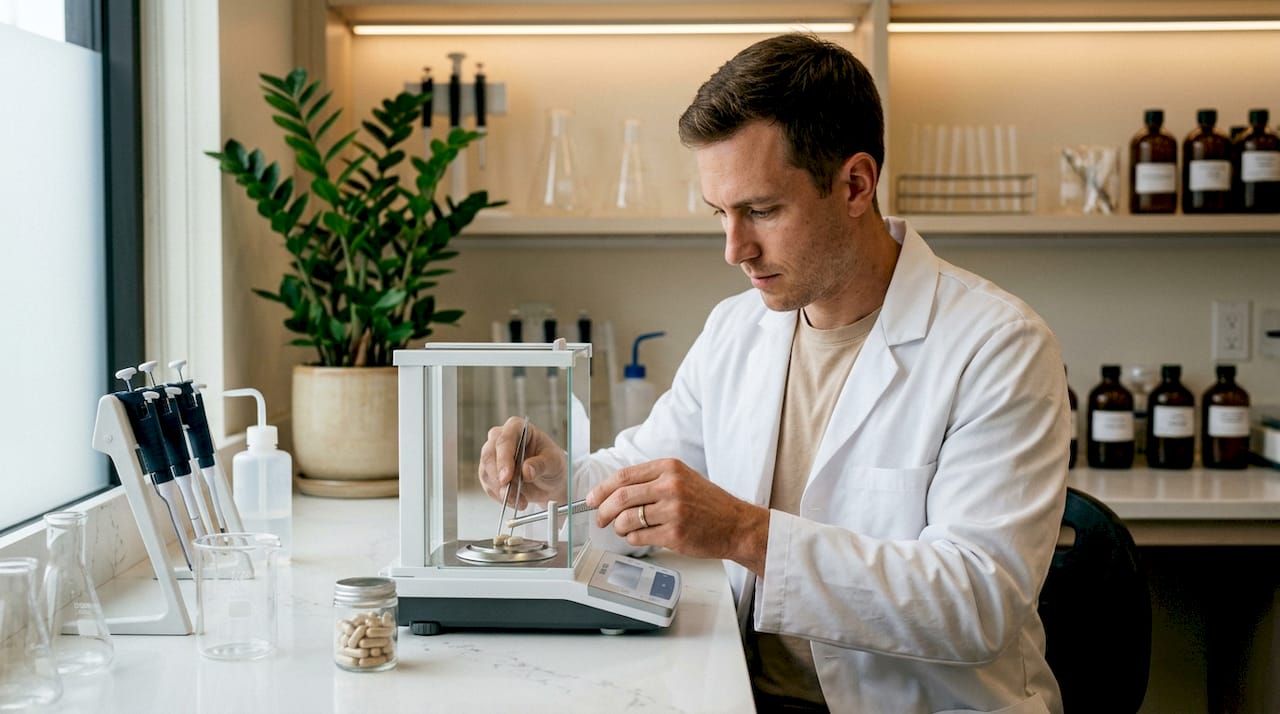
Lab turnaround time ranges from 48 hours for basic identity checks to several weeks for comprehensive panels. The complexity of the product and the number of tests ordered determine how long the process takes. A simple single-ingredient capsule moves through faster than a multi-ingredient botanical powder.
ISO/IEC 17025 accreditation is the international gold standard for testing labs. It confirms that a lab has been independently assessed for technical competence, equipment calibration, and validated methods. Without this accreditation, there is no independent guarantee that results are reliable or reproducible.
Every test run produces a Certificate of Analysis (COA). A COA lists the test types performed, the methods used, the acceptable ranges, and the actual results for that specific batch. The batch number on the COA must match the batch number on the product. If it does not match, the document is not valid evidence for that product.
Key steps in the third-party testing process:
- The manufacturer submits raw ingredients or finished product samples to the lab.
- The lab runs identity, potency, purity, and contaminant tests using validated methods.
- Results are compared against label claims and acceptable safety thresholds.
- The lab issues a batch-specific COA with detailed findings.
- The brand either passes, fails, or reformulates based on results.
Pro Tip: Always ask a brand for the COA that matches the batch number printed on your specific bottle. A COA from a different batch tells you nothing about what you are holding.
What are the types of supplement purity tests?
Third-party supplement testing covers eight distinct test categories. Understanding each one helps you evaluate what a "third-party tested" claim actually covers.
- Identity testing confirms that the ingredients in the product match what the label states. Labs use HPLC and FTIR to fingerprint compounds and verify authenticity.
- Potency testing measures whether the actual amount of each active ingredient matches the labeled dose. A supplement claiming 500mg of ashwagandha must contain 500mg, not 300mg.
- Heavy metal testing screens for arsenic, lead, cadmium, and mercury using USP 2232 protocols. This is especially critical for botanical supplements because plants bioaccumulate toxins from contaminated soil.
- Microbial testing checks for harmful bacteria, yeast, and mold per USP 61 and 62 standards.
- Pesticide residue testing detects agricultural chemicals that may remain in plant-derived ingredients.
- Residual solvent testing identifies leftover chemical solvents from extraction processes.
- Dissolution testing measures how well a tablet or capsule breaks down in the body, which directly affects absorption.
- Stability testing confirms that a product retains its potency and safety throughout its stated shelf life.
The phrase "third-party tested" on a label may refer to only one or two of these categories. A brand that ran only identity testing technically passed a third-party test, but that tells you nothing about heavy metals or potency accuracy.
| Test category | What it verifies |
|---|---|
| Identity | Ingredients match label claims |
| Potency | Active ingredient amounts are accurate |
| Heavy metals | Arsenic, lead, cadmium, mercury within safe limits |
| Microbial | No harmful bacteria, yeast, or mold present |
| Stability | Product retains quality through expiration date |
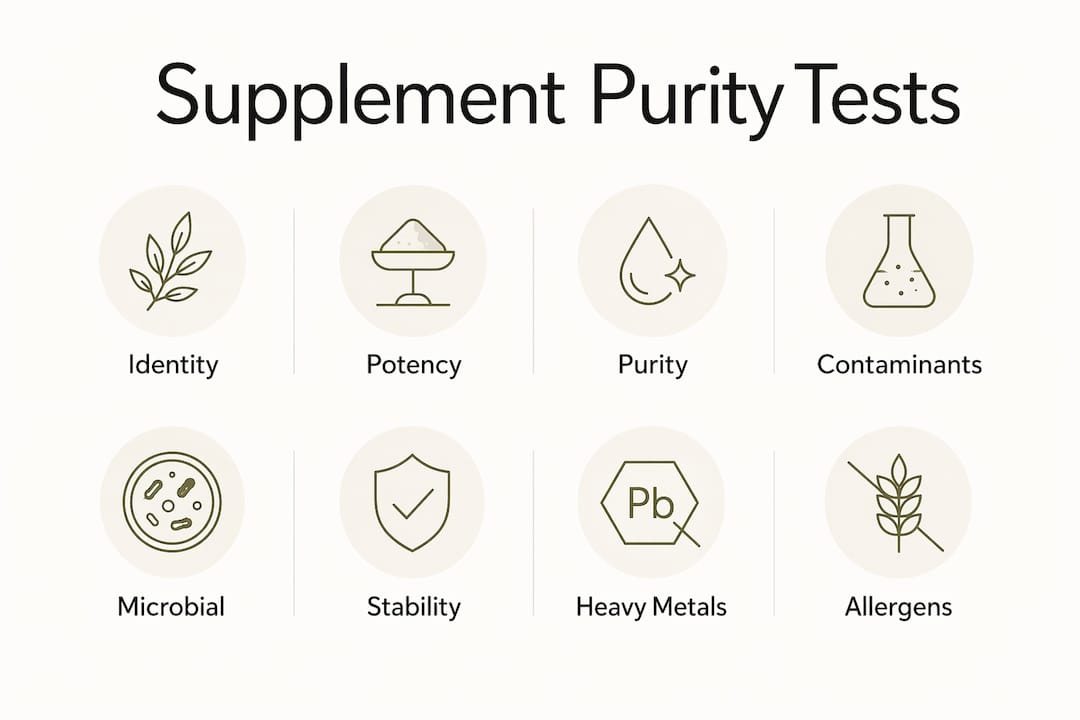
Comprehensive testing across all eight categories is expensive. That cost is why many brands test selectively. The brands that invest in full-panel testing are signaling a genuine commitment to quality, not just a marketing checkbox.
Pro Tip: When a brand lists "third-party tested," ask which specific tests were run. A brand confident in its quality will answer that question directly.
How can you verify a supplement's third-party testing claims?
Verification starts with identifying the specific organization behind the certification. Named certifiers like USP, NSF, and BSCG each run structured programs with public databases where you can confirm a product's certification status. NSF Certified for Sport screens for more than 270 banned substances. BSCG screens for more than 700. These programs include ongoing batch testing and facility audits, not just a single lab check.
A logo on a label is not proof of certification. Certification logos can be forged or used after a certification has lapsed. The only reliable verification is finding the product listed in the certifier's official public database, or obtaining a batch-specific COA from the manufacturer.
What to look for when verifying a supplement's testing claims:
- The name of the specific testing organization, not just a generic "tested" claim.
- A batch-specific COA that matches the lot number on your product.
- ISO/IEC 17025 lab accreditation for the lab that issued the COA.
- Confirmation of the test scope: which parameters were tested and which methods were used.
- The product listed in the certifier's public online database.
One-time testing and ongoing certification programs are not the same thing. Ongoing programs like NSF and USP Verified include regular batch testing and facility audits. A brand that tested one batch two years ago and never retested cannot claim current certification status.
Beware of vague language like "manufactured in a certified facility." Facility certification covers manufacturing practices, not product quality. A supplement can be made in a certified facility and still contain the wrong ingredients or wrong amounts.
Pro Tip: Search the NSF or USP public databases directly. Type in the product name or brand. If it does not appear, the certification claim is unverified.
Why does third-party testing matter for supplement safety?
The FDA does not evaluate dietary supplements before they go on sale. Under DSHEA 1994, a supplement can reach consumers without any pre-market safety review. Third-party testing is the primary mechanism that fills this gap with objective, verifiable data.
Contamination is a real and documented risk. Botanical supplements are especially vulnerable to heavy metal contamination because plants absorb toxins from the soil they grow in. Even a well-intentioned manufacturer using quality raw materials can unknowingly source from contaminated soil. Without testing, those toxins reach consumers.
Third-party testing does not just protect you from bad actors. It protects you from honest mistakes. A manufacturer can follow every good manufacturing practice and still sell a contaminated product if the source ingredients were never tested for heavy metals or pesticides.
Dosing consistency is another critical benefit. Health outcomes from supplements depend on receiving the labeled dose consistently. A product that delivers 60% of its stated dose in one batch and 130% in the next creates unpredictable results. Potency testing catches this variation before it reaches you.
Athletes face an additional layer of risk. Supplements contaminated with undisclosed stimulants or banned substances can trigger positive drug tests. Programs like NSF Certified for Sport exist specifically to address this risk by screening for substances prohibited by major sports organizations.
For anyone choosing clean ingredient supplements for long-term wellness, third-party verification is the clearest signal that a brand's quality claims are backed by data, not just marketing language.
What third-party testing does not guarantee
Third-party testing confirms quality, purity, and label accuracy. It does not assess clinical effectiveness or guarantee that a supplement will produce specific health benefits for any individual. A product can pass every purity test and still not work for your particular health goal.
Testing scope and rigor vary widely across labs and programs. Not all accredited labs test for the same parameters or use the same methods. A COA from one lab may cover five test categories while a COA from another covers two. The accreditation confirms the lab's competence within its scope, not the breadth of what it tested.
Third-party testing also does not account for individual medical needs, drug interactions, or pre-existing conditions. A supplement that is pure and accurately labeled may still be inappropriate for someone on specific medications or with certain health conditions. That determination requires a healthcare provider, not a lab report.
One-time testing is insufficient for ongoing quality assurance. Ingredient sources change, manufacturing conditions shift, and batch-to-batch variation is real. A brand committed to quality runs testing on every production batch, not just the first one.
Key Takeaways
Third-party testing is the most reliable way to verify that a supplement contains what its label claims, at the right dose, and free from harmful contaminants.
| Point | Details |
|---|---|
| FDA does not pre-approve supplements | Third-party testing fills the regulatory gap left by DSHEA 1994. |
| COAs are the gold standard | Batch-specific Certificates of Analysis are more reliable than logos or generic claims. |
| ISO/IEC 17025 matters | Only use labs with this accreditation to confirm results are technically valid. |
| "Third-party tested" is not one thing | The phrase may cover only identity testing; always ask which specific tests were run. |
| Ongoing certification beats one-time testing | Programs like NSF and USP Verified include regular audits, not just a single lab check. |
What I have learned from watching brands get testing wrong
The supplement industry has a transparency problem that most marketing language papers over. After working closely with wellness brands on quality verification, the pattern I see most often is this: brands invest in testing once, print a logo, and treat it as a permanent credential. That is not how quality works.
The phrase "third-party tested" has become so overused that it has lost most of its meaning. I have reviewed COAs that covered only identity testing on raw ingredients, with no finished-product testing at all. Technically accurate. Practically misleading.
What actually separates a trustworthy supplement brand from a marketing-forward one is whether they can hand you a batch-specific COA, name the lab, and confirm that lab holds ISO/IEC 17025 accreditation. Most brands cannot do all three. The ones that can are worth your attention.
The trend toward stricter consumer scrutiny is real and accelerating. More people are asking for COAs, checking NSF databases, and reading test scopes before buying. That pressure is good for the industry. Brands that cannot answer basic verification questions will lose ground to those that can. At Sacrahaus, we see clean label transparency as a baseline requirement, not a differentiator.
— Sacrahaus
Sacrahaus and third-party tested vegan supplements
Sacrahaus formulates every product with plant-based ingredients verified through independent lab testing for potency, purity, and contaminant-free status. Every batch is tested at ISO/IEC 17025-accredited labs, and batch-specific Certificates of Analysis are available on request.

The vegan supplement collection covers adaptogens, botanicals, functional mushrooms, and mineral formulas, all non-GMO and made in the USA. For those focused on foundational nutrition, the vegan essentials range includes iron, magnesium, creatine, and greens, each backed by verifiable lab data. When a brand's quality claims are this specific, you can check them. That is the point.
FAQ
What does "third-party tested" mean on a supplement label?
It means an independent lab with no financial connection to the manufacturer has tested the product. The scope of that testing varies widely, so always ask which specific tests were performed.
How do I verify a supplement's third-party testing claim?
Search the certifier's public database (NSF, USP, or BSCG) for the product by name, or request a batch-specific COA from the manufacturer that matches the lot number on your bottle.
Does third-party testing prove a supplement will work?
No. Third-party testing confirms identity, potency, and purity. It does not assess clinical effectiveness or guarantee health outcomes for any individual.
What is ISO/IEC 17025 and why does it matter?
ISO/IEC 17025 is the international accreditation standard for testing labs. It confirms the lab has been independently assessed for technical competence and valid methods, making its results defensible and reproducible.
Are NSF and USP certifications better than a generic "third-party tested" claim?
Yes. NSF Certified for Sport and USP Verified involve ongoing batch testing and facility audits, which provide far stronger assurance than a one-time lab test or an unverified logo on a label.