
TL;DR:
- USA-made supplement standards rely on FDA cGMP compliance and third-party certifications. Verifying batch test results and supplier records ensures product quality. Independent audits like NSF and USP provide credible assurance beyond basic regulations.
USA-made supplement quality standards are the regulatory and certification frameworks that govern how supplements are manufactured, tested, labeled, and sold in the United States. The two foundational pillars are the FDA's 21 CFR Part 111 current Good Manufacturing Practices (cGMP) and the FTC's "Made in USA" labeling rule. Beyond those legal baselines, third-party certifications like NSF/ANSI 455-2 GMP and USP Verified give consumers an independent layer of quality assurance. Understanding how these systems work together is the difference between choosing a supplement you can trust and one that only looks credible on the label.
What federal regulations govern USA-made supplements?
The FDA's 21 CFR Part 111 cGMP regulation is the legal backbone of US supplement manufacturing standards. It covers every stage of production: raw material sourcing, in-process controls, finished product testing, labeling, and record-keeping. Manufacturers must verify raw material identity for every incoming lot and test finished products for purity, strength, and composition before releasing them for sale. Skipping or shortcutting either step is the leading cause of FDA citations.

The FDA's inspection record tells a clear story about domestic supplement quality control. cGMP violations are the most common inspection finding, with roughly 50% of dietary supplement facilities receiving citations as of 2026. The US supplement industry spans approximately 15,000 manufacturers and 80,000 products generating $69 billion annually. That scale makes consistent enforcement difficult, which is exactly why understanding the rules yourself matters.
The FTC's "Made in USA" labeling rule adds a separate layer of legal accountability. Under the 2021 FTC update, a product can only carry an unqualified "Made in USA" claim if "all or virtually all" of its content is processed and assembled domestically. Violations now carry civil penalties. That means a label reading "Made in USA" is a legal statement, not just a marketing phrase.
Key compliance requirements under 21 CFR Part 111 include:
- Identity testing of every raw material lot before use in production
- Finished product testing for potency, purity, and composition before release
- Master manufacturing records documenting every step of each production batch
- Supplier qualification records showing ingredient sourcing and vendor vetting
- Labeling accuracy verified against actual formulation and regulatory requirements
One critical distinction: the FDA does not approve dietary supplements before they reach the market. The FDA monitors compliance through inspections, not pre-market review. FDA registration is an administrative listing process and carries no endorsement of a product's quality or safety. A registered facility is not a certified or inspected facility.
How are supplements tested and quality-controlled in US facilities?
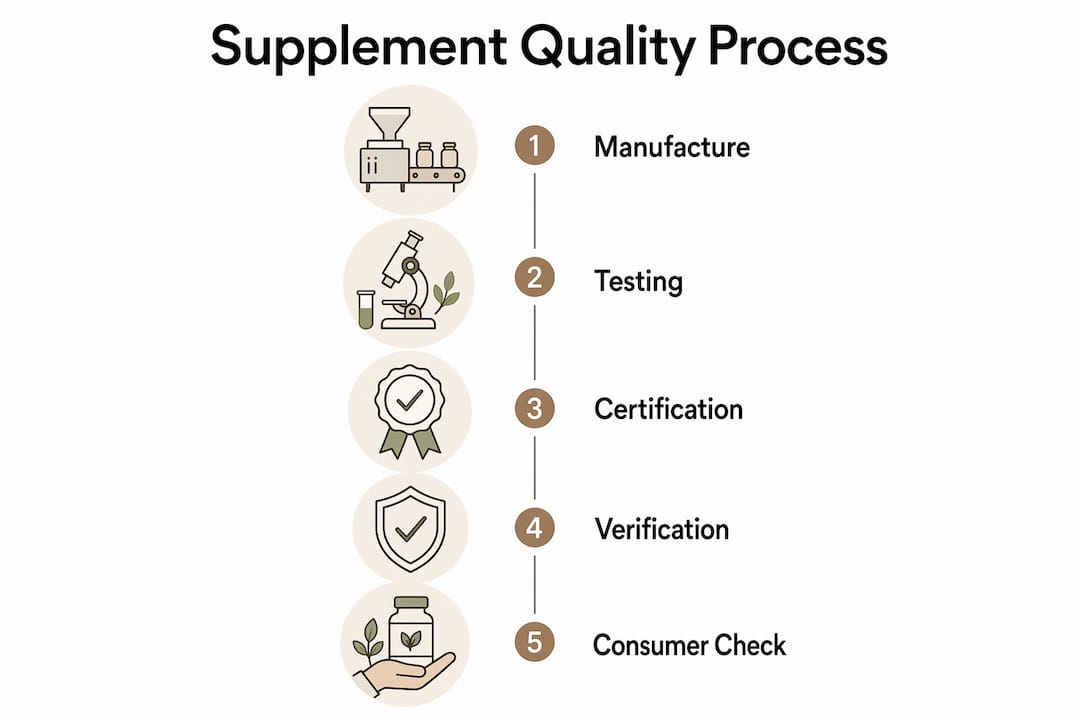
Quality control in a cGMP-compliant US facility follows a defined sequence from raw materials to finished product. Each step generates documentation that regulators and third-party auditors can review. The process is only as strong as its weakest link, and inadequate documentation is consistently the biggest compliance failure point, not lack of effort on the manufacturing floor.
The standard testing sequence works like this:
- Incoming raw material testing. Every lot is tested for identity before entering production. Botanical ingredients require additional testing for heavy metals, pesticides, and microbial contamination.
- In-process controls. Checks during manufacturing verify that blending, encapsulation, or tableting meets specification at each stage.
- Finished product release testing. The final product is tested for potency, purity, and microbial limits before it ships.
- Batch Certificates of Analysis (COAs). Each batch receives a COA documenting test results. A credible COA includes identity, potency, heavy metals, and microbial results specific to the product's risk profile.
- Supplier qualification. Manufacturers maintain records on every ingredient supplier, including their own testing data and audit history.
COAs for each batch should show specific results for heavy metals in botanicals or microbial testing in gummies, tailored to the product's actual risk. A generic COA that lists only a few parameters is a red flag. You can also cross-reference the facility address on the COA against the manufacturer's GMP certificate to confirm the product was actually made where the label claims.
Pro Tip: Ask any supplement brand for the COA from the specific lot number on your bottle. If they cannot provide one, or if the COA lacks heavy metals and microbial results, treat that as a quality concern.
Supplier qualification is often overlooked by consumers, but is central to clean ingredient verification. A manufacturer that cannot trace an ingredient back to its origin cannot guarantee what is actually in the bottle.
What third-party certifications validate USA manufacturing quality?
Third-party certifications go beyond what the FDA legally requires. They involve independent audits of facilities, processes, and finished products conducted by accredited organizations. NSF/ANSI 455-2 GMP and USP Verified are the two most recognized standards, and large retailers and digital marketplaces often require them as a condition of listing.
Here is what each major certification covers:
- NSF/ANSI 455-2 GMP. Audits the manufacturing facility against a detailed GMP standard. Covers facility conditions, equipment, personnel training, documentation, and testing practices. Annual facility audits plus unannounced inspections.
- USP Verified. Tests finished products for identity, potency, purity, and disintegration. The USP mark on a label means the product was independently tested and met the published standard for that ingredient.
- NPA GMP Certification. The Natural Products Association's GMP program audits facilities against a standard aligned with FDA 21 CFR Part 111. Widely recognized in the natural products industry.
The critical difference between FDA compliance and third-party certification is verification. The FDA inspects less than 2% of supplement facilities annually. A third-party certification means an independent auditor has physically reviewed the facility and its records, often more frequently than the FDA ever will. That independent audit is what gives third-party certifications their value.
Pro Tip: Verify any certification claim by searching the certifying body's public registry. NSF, USP, and NPA all maintain searchable databases. If a brand claims certification but the facility does not appear in the registry, the claim is unverified.
Retailers value these certifications because they reduce liability. Consumers should value them because they represent objective evidence of quality, not a marketing promise.
How can consumers verify the quality of USA-made supplements?
Reading a supplement label critically is a skill. Most labels contain a mix of regulated claims, voluntary certifications, and marketing language. Knowing which is which protects you from paying a premium for an unverified product.
Start with these verification steps:
- Check the "Made in USA" claim. Under FTC rules, this means "all or virtually all" content is domestic. Many products labeled "Made in USA" use globally sourced ingredients but are manufactured or packaged domestically. Ask the brand for per-batch sourcing documentation if ingredient origin matters to you.
- Look for a named third-party certification. "GMP-certified" without naming the certifying body is a vague claim. NSF, USP, or NPA certification with a verifiable registry listing is specific and meaningful.
- Request the batch COA. Any reputable brand will provide the COA for your specific lot number. Confirm it includes heavy metals, microbial results, and potency data.
- Search FDA inspection records. The FDA publishes Warning Letters and inspection findings on its website. Searching a manufacturer's name takes under two minutes and can reveal recent compliance failures.
- Ask about ingredient sourcing. "Made in USA" and "ingredients sourced in USA" are different claims. Confirm which applies to the product you are buying.
"The most reliable signal of supplement quality is not the label. It is the documentation behind the label: batch COAs, third-party audit reports, and supplier qualification records. A brand that shares these without hesitation has nothing to hide."
Industry experts consistently recommend documented third-party audits over marketing claims as the most reliable way to assess supplement quality. That recommendation holds whether you are buying a basic multivitamin or a specialized adaptogen formula.
What are common misconceptions about USA supplement quality standards?
Several widespread misunderstandings lead consumers to trust labels they should question. Clearing them up takes less than a minute and can meaningfully improve the quality of what you put in your body.
- "FDA-approved" supplements exist. The FDA does not approve dietary supplements. It sets manufacturing rules and inspects for compliance. No supplement carries FDA approval.
- "FDA-registered" means inspected or certified. FDA registration is an administrative listing. It does not mean the facility has been inspected or that its products meet any quality standard.
- "Made in USA" guarantees domestic ingredients. The FTC standard requires domestic manufacturing and assembly, not domestic ingredients. A product can legally carry the "Made in USA" label while using ingredients sourced from multiple countries.
- "Formulated in USA" equals "Made in USA." "Formulated in USA" is a marketing phrase with no regulatory definition. It does not meet the FTC's "all or virtually all" standard and carries no legal weight.
- All GMP certifications are equivalent. GMP certification from an accredited body like NSF or NPA involves rigorous audits. A self-declared "GMP-compliant" claim from the manufacturer itself has no independent verification behind it.
Consumers who mistake FDA regulation for FDA approval are the most vulnerable to misleading marketing. The FDA monitors the supplement industry, but it does not endorse any product. That distinction is the foundation of informed supplement buying.
Key Takeaways
USA-made supplement quality standards require both mandatory FDA cGMP compliance and voluntary third-party certification to deliver genuinely verified safety and efficacy.
| Point | Details |
|---|---|
| FDA cGMP is the legal baseline | 21 CFR Part 111 requires identity testing, batch records, and finished product testing before release. |
| FDA does not approve supplements | Registration is administrative; certification requires independent third-party audits. |
| "Made in USA" has a legal definition | The FTC requires "all or virtually all" content to be domestic; ingredients may still be imported. |
| COAs are your best verification tool | Request the batch COA for your lot number and confirm it includes heavy metals and microbial results. |
| Third-party certifications add real value | NSF/ANSI 455-2, USP Verified, and NPA GMP involve independent audits that go beyond FDA inspection frequency. |
What I have learned from years inside the supplement quality conversation
The single most consistent pattern I have seen is this: brands that lead with documentation are the ones worth trusting. Brands that lead with marketing language are the ones worth questioning. That is not cynicism. It is pattern recognition.
The "Made in USA" label is a good starting point, but it is not a finish line. I have seen products carrying that label with ingredient supply chains that span four continents. The label was technically accurate under FTC rules. The consumer had no idea. That gap between legal accuracy and practical transparency is where most supplement quality problems live.
Third-party certification changed my thinking on what "quality" actually means in this industry. An NSF or USP audit is not a rubber stamp. It is a structured, documented review of a facility's actual practices. When a brand passes that audit and publishes the result, it is making a verifiable claim. That is categorically different from a brand printing "premium quality" on a label.
The regulatory environment is tightening. FDA enforcement of cGMP violations has become more consistent, and FTC scrutiny of origin claims has increased since the 2021 rule update. Brands that built their quality systems on documentation and independent audits are well-positioned. Brands that relied on marketing language are facing real exposure. As a consumer, you benefit from that shift. But you still have to do the work of asking the right questions.
— Sacrahaus
Sacrahaus supplements and USA quality standards
Sacrahaus builds every product on a foundation of cGMP-compliant US manufacturing and independent third-party testing. Each batch goes through identity, potency, and purity verification before it ships, and the documentation is available to back it up.

The vegan supplement collection covers adaptogens, botanicals, mushroom complexes, functional powders, and gummies, all formulated without animal-derived ingredients and produced in facilities that meet the standards described in this article. You can review the full manufacturing process on the Sacrahaus website, including details on third-party testing practices and ingredient sourcing. If verified quality and transparent documentation matter to you, that is the right place to start.
FAQ
Does the FDA approve dietary supplements before they are sold?
The FDA does not approve dietary supplements before sale. It sets manufacturing standards under 21 CFR Part 111 and inspects facilities for compliance, but no supplement carries FDA pre-market approval.
What does "Made in USA" legally require on a supplement label?
The FTC requires that "all or virtually all" of the product be processed and assembled in the United States. Ingredients may still be sourced internationally and the label can remain legally compliant.
How can I verify a supplement's GMP certification?
Search the certifying body's public registry. NSF, USP, and NPA each maintain searchable databases where you can confirm whether a specific facility holds a current, valid certification.
What should a Certificate of Analysis include?
A credible COA lists identity, potency, heavy metals, and microbial test results specific to the product's ingredients and risk profile. A COA that omits heavy metals for botanical ingredients or microbial results for gummies is incomplete.
Is "Formulated in USA" the same as "Made in USA"?
No. "Formulated in USA" is a marketing phrase with no regulatory definition. It does not meet the FTC's legal standard for an unqualified "Made in USA" claim and carries no independent verification.