
TL;DR:
- Whole food vitamins are supplements made from concentrated, dehydrated real foods that provide nutrients in natural combinations. They include cofactors and enzymes that enhance absorption, unlike synthetic vitamins that often lack these synergistic components. These supplements serve best as nutritional insurance and should complement a balanced diet for long-term wellness.
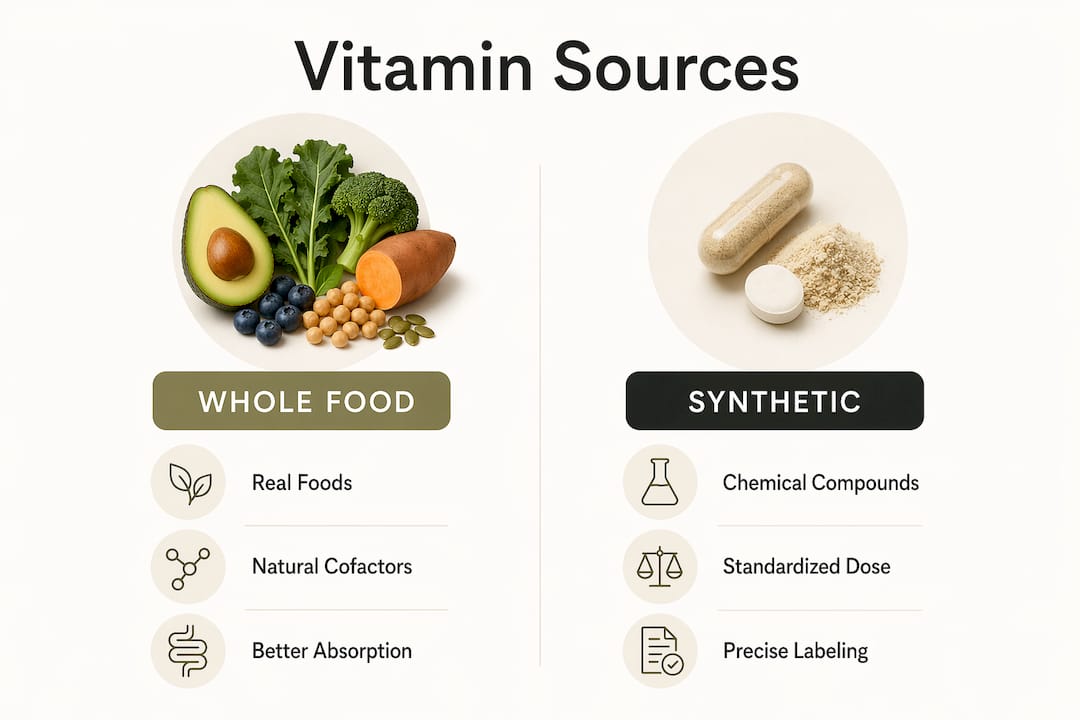
Whole food vitamins are supplements made from concentrated, dehydrated real foods that deliver vitamins, minerals, enzymes, and cofactors in the same combinations your body finds in nature. Unlike isolated synthetic nutrients, these supplements preserve the food matrix, the network of fiber, phytonutrients, and enzymes that surrounds each nutrient in its original source. The term "whole food vitamins" is widely used by consumers, though the supplement industry often calls them food-based or food-matrix supplements. Understanding the difference between these and conventional synthetic vitamins helps you make smarter choices for your nutrition and long-term wellness.
What are whole food vitamins and how do they work?
Whole food vitamins are defined by their source: real, recognizable foods rather than chemically synthesized compounds. A whole food vitamin C supplement, for example, comes from acerola cherry or amla fruit, not from ascorbic acid manufactured in a lab. The nutrient arrives packaged with bioflavonoids, enzymes, and fiber that exist naturally in the fruit.

This distinction matters because your body does not absorb nutrients in isolation the way textbooks sometimes suggest. Registered Dietitian Nutritionist Shelley Rael confirms that nutrient synergy in whole foods does not typically occur in synthetic supplements. That synergy is the reason an orange delivers more nutritional value than a pure ascorbic acid tablet at the same milligram dose.
Whole food supplements are regulated internationally as foods, not drugs. That classification means they serve best as nutritional insurance rather than dietary replacements. They fill gaps in an already solid diet. They do not replace the diet itself.
What nutrients and cofactors make these supplements different?
The food matrix is the defining feature of any genuine whole food vitamin. It includes fiber, enzymes, cofactors, and phytonutrients that travel alongside the primary vitamin or mineral. A powder containing only isolated vitamins lacks synergistic compounds found in whole foods, which directly affects how well your body absorbs and uses each nutrient.
Common nutrients found in whole food vitamins include:
- Vitamin C from acerola cherry, camu camu, or rose hip, delivered with bioflavonoids
- Vitamin A from carrot concentrate or spirulina, paired with natural carotenoids
- B vitamins from nutritional yeast or fermented grains, with natural folate instead of folic acid
- Iron from spinach concentrate or, in non-vegan products, heme iron from grass-fed organ meats
- Zinc from pumpkin seed extract, accompanied by natural fatty acids
Each of these pairings matters. Bioflavonoids increase vitamin C uptake. Natural carotenoids convert to vitamin A more safely than preformed retinol. Folate from food is metabolized differently than synthetic folic acid, which is significant for people with MTHFR gene variants.
Pro Tip: Check the ingredient list for recognizable food names rather than chemical compound names. "Ascorbic acid from acerola cherry" is a whole food source. "Ascorbic acid" alone is synthetic.
Sacrahaus formulates its plant-based supplements with botanicals, adaptogens, and mushrooms specifically to preserve this food-matrix effect. That approach reflects the same principle Shelley Rael describes: nutrients work together, not in isolation.
How do whole food vitamins compare with synthetic vitamins?
No definitive superiority exists between synthetic and whole food supplements. Each serves different nutritional goals, and the right choice depends on your diet, budget, and health objectives.
| Criteria | Whole food vitamins | Synthetic vitamins |
|---|---|---|
| Nutrient source | Real foods, plants, or organ concentrates | Chemically isolated compounds |
| Bioavailability | Higher for some nutrients due to food matrix | Variable; often high for simple vitamins like B12 |
| Cofactors included | Yes, naturally present | Rarely included |
| Cost | Generally higher | Generally lower |
| Nutrient range | Narrower per serving | Broader, easier to standardize doses |
| Label transparency | Recognizable food ingredients | Chemical compound names |
Synthetic vitamins do have real advantages. They deliver precise, standardized doses, which matters when a clinician prescribes a specific amount to correct a deficiency. Synthetic B12 in cyanocobalamin form, for instance, is well-absorbed and widely used in clinical settings. Synthetic vitamins also cost less to produce, making them accessible to people on tight budgets.
Whole food vitamins win on transparency and cofactor content. Wellness experts note that clean-label consumers favor whole food supplements precisely because they can read and recognize every ingredient. That matters if you follow a plant-based diet, avoid artificial additives, or simply want to know what you are putting in your body.
Pro Tip: If you are correcting a diagnosed deficiency, work with a clinician who may recommend a synthetic form for its precision. If you are supporting general wellness with no acute deficiency, a whole food supplement often fits better with a clean-nutrition approach.
What does research say about whole food vitamin effectiveness?
The research picture is honest and worth understanding clearly. Harvard Health states that multivitamins do not reduce heart disease or mental decline risk but may lower cancer risk in some groups. That finding comes from large-scale trials including the Physicians' Health Study II and the COSMOS trial. Both studies tracked tens of thousands of participants over years and found mixed results across different health outcomes.
The US Preventive Services Task Force states no evidence to encourage or discourage multivitamin use for cardiovascular or cancer prevention. That is not a dismissal of supplements. It means the science has not yet produced a clean verdict, and individual results vary based on diet, genetics, and baseline nutrient status.
What research does support clearly:
- Supplements fill genuine gaps for people with restricted diets, including vegans who need B12 and D3
- Pregnant people benefit from folate supplementation to reduce neural tube defect risk
- Older adults absorb B12 less efficiently from food and benefit from supplemental forms
- People with limited sun exposure consistently show low vitamin D levels that supplementation corrects
The key misconception to avoid is treating supplements as a substitute for food. Whole food vitamins work best when your diet already includes vegetables, legumes, whole grains, and quality protein. They cover the gaps. They do not build the foundation.
Excess intake carries real risk. Fat-soluble vitamins A, D, E, and K accumulate in tissue. Taking high doses of synthetic vitamin A, for example, causes toxicity. Whole food sources of vitamin A deliver beta-carotene, which your body converts to retinol only as needed, making overdose far less likely. That built-in safety mechanism is one concrete advantage of food-matrix delivery.
How to choose whole food vitamins for your wellness goals
Choosing the right supplement starts with knowing your actual nutrient gaps, not guessing based on marketing. A blood panel from your doctor gives you a baseline for vitamin D, B12, iron, and magnesium. That data tells you where to focus.
- Identify your diet's weak points. Vegans need B12, D3, iodine, and omega-3s. People who avoid dairy often need calcium and K2. People who rarely eat leafy greens often run low on magnesium and folate.
- Read the ingredient list, not just the front label. Authentic whole food vitamins list recognizable food-sourced ingredients like spirulina, amla fruit, or fermented yeast. If the label lists only chemical compound names, the product is synthetic regardless of marketing claims.
- Check for third-party testing. Look for NSF International, USP, or Informed Sport certification seals. These confirm the product contains what the label claims and is free from contaminants.
- Match the format to your routine. Capsules, powders, and gummies each have different absorption profiles. Powders dissolve quickly and often absorb faster. Gummies are convenient but may contain added sugars. Capsules are neutral and easy to dose precisely.
- Consider stacking thoughtfully. Calcium and iron compete for absorption. Take them at different times of day. Fat-soluble vitamins absorb better with a meal that contains healthy fat. Magnesium taken at night supports sleep quality as a secondary benefit.
Pro Tip: Look for supplements that list the food source in parentheses next to the nutrient name. "Vitamin C (from acerola cherry)" tells you exactly what you are getting. That level of transparency is a reliable quality signal.
Learning how to identify clean ingredient supplements before you buy saves money and prevents the frustration of paying premium prices for products that do not deliver on their whole food claims.
Key Takeaways
Whole food vitamins deliver nutrients inside a natural food matrix that improves absorption, provides cofactors, and supports wellness in ways isolated synthetic compounds cannot fully replicate.
| Point | Details |
|---|---|
| Food matrix matters | Cofactors, enzymes, and fiber in whole food vitamins improve how your body absorbs each nutrient. |
| Research is honest | Studies show supplements reduce some nutrient gaps but do not replace the health benefits of a whole-food diet. |
| Synthetic has its place | Synthetic vitamins offer precise dosing and lower cost, making them useful for correcting diagnosed deficiencies. |
| Label reading is non-negotiable | Authentic whole food supplements list recognizable food sources, not just chemical compound names. |
| Gaps, not foundations | Whole food vitamins work best as nutritional insurance on top of a solid diet, not as a replacement for one. |
Why I think most people misunderstand whole food vitamins
The wellness world tends to frame whole food vitamins as the obvious winner over synthetic supplements, and that framing does real harm. It leads people to spend more money than necessary on products they do not need, or worse, to believe a supplement can compensate for a poor diet.
My honest view, shaped by years of working in natural wellness, is that the food matrix concept is genuinely important but frequently misapplied. The synergy between nutrients in real food is real. Eating a handful of almonds delivers vitamin E, magnesium, and healthy fat together in a way no capsule fully replicates. That is a fact worth respecting.
Where I push back is on the idea that a whole food supplement automatically delivers that same synergy. A capsule of dehydrated spinach powder is better than isolated iron sulfate, but it is still not spinach. The gap between a supplement and the actual food is smaller with whole food products, but it exists. Keeping that perspective prevents the kind of magical thinking that makes people skip vegetables because they take a greens supplement.
The approach I recommend is simple. Build your diet around whole food nutrition first. Then use supplements to cover the specific gaps your diet cannot realistically fill, whether that is B12 for a vegan lifestyle, vitamin D in a northern climate, or magnesium for someone under chronic stress. Choose products with transparent labels, third-party testing, and real food sources. Consult a registered dietitian or physician before adding anything new, especially if you take medications or manage a health condition.
Supplements are a tool. Whole food vitamins are a better-designed tool than most. But the hand that holds the tool still matters more than the tool itself.
— Sacrahaus
Sacrahaus whole food supplements for clean, plant-based nutrition
Sacrahaus builds its supplement line around the same principles this article covers: real ingredients, transparent labels, and formulas that work with your body rather than around it.

Every product in the Sacrahaus catalog is third-party tested, non-GMO, and made in the USA. The vegan essentials collection covers the nutrient gaps most common in plant-based diets, including iron, magnesium, and mineral support sourced from clean, recognizable ingredients. For those who prefer concentrated plant nutrition in powder form, the vegan supplement powders range delivers botanical and adaptogen blends designed to complement a whole food diet. Browse the full range to find the specific support your wellness routine needs.
FAQ
What are whole food vitamins made from?
Whole food vitamins are made from concentrated, dehydrated real foods such as fruits, vegetables, fermented grains, and botanical extracts. They retain the natural cofactors, enzymes, and phytonutrients present in the original food source.
Are whole food vitamins more effective than synthetic vitamins?
No single type is universally more effective. Whole food vitamins offer better cofactor content and label transparency, while synthetic vitamins provide precise dosing and lower cost. The best choice depends on your specific nutrient needs and health goals.
Can whole food vitamins replace a healthy diet?
Whole food vitamins cannot replace a balanced diet. Harvard Health confirms they serve best as nutritional insurance to fill gaps, not as a substitute for eating vegetables, whole grains, and quality protein.
How do I know if a supplement is truly a whole food vitamin?
Check the ingredient list for recognizable food names listed next to each nutrient, such as "vitamin C from acerola cherry." Products that list only chemical compound names are synthetic, regardless of how they are marketed.
Are whole food vitamins safe to take daily?
Whole food vitamins are generally safe for daily use because food-matrix delivery reduces the risk of fat-soluble vitamin toxicity. Beta-carotene from food, for example, converts to vitamin A only as your body needs it. Always consult a healthcare provider before starting any new supplement, particularly if you take prescription medications.